Last updated: November 19, 2026
Key Takeaways
- A debt is legally collectible when the law still lets a creditor or debt collector sue or use other lawful collection tools.
- You can check that in a few steps, and each step gives a different clue.
- The documents matter because a collector’s letter is not proof by itself.
- Old debt causes trouble because people confuse age with enforceability.
A debt can still be legally collectible in your state even if it is old, but the answer turns on state law, the statute of limitations, and whether the creditor or debt collector has the right papers. This guide shows what to check before you do anything else. It also flags the points where an old debt stops being a simple paperwork problem and becomes a legal one. The topic here is how to tell whether a debt is legally collectible in your state.
What “legally collectible” means in plain English
A debt is legally collectible when the law still lets a creditor or debt collector sue you or use other lawful collection tools on it. That does not mean every collection tactic is allowed forever, and it does not mean the debt has disappeared just because it is old.
Picture this: you have a letter about a credit card bill from years ago, and the balance looks wrong. You want to know if the collector can still enforce it in court, or if the clock has run out under your state’s rules. The answer depends on state law, the type of debt, and the last real activity on the account.
A collector can still ask for payment after the clock runs in many states. That part surprises people. The better question is whether the debt is still legally enforceable through a lawsuit, which is where the statute of limitations matters. The Federal Trade Commission explains that time-barred debt can still be collected in some situations, even when a lawsuit is blocked.
- State law controls the time limit.
- The clock can reset in some states after a payment or written promise.
- Different debts can have different limits.
- A debt may still appear on a credit report even when a lawsuit is time-barred.
This page is about the decision point: is the debt still collectible under the law where you live, or is it only being pursued as an old account with no court remedy?
How do I tell whether a debt is still collectible in my state?
A debt is still collectible if the claim is within your state’s lawsuit deadline, the collector has the right to sue, and the debt can be tied to you with valid records. You can check that in a few steps, and each one gives you a different clue.
Start with what you need first: the collector’s notice, your records for the account, and the state where you lived when the debt became due. If you do not have the original contract, the billing history still helps. The Consumer Financial Protection Bureau says debt collectors must send a validation notice with key details, usually within 5 days of first contact.
- Identify the debt type. Sort it as credit card, medical bill, auto deficiency, personal loan, or utility bill. Each type can have a different limitation period in some states. Verify the account name and the last four digits on the notice. A mismatch, a wrong balance, or a debt you never opened is a problem.
- Find the state law that controls the clock. Check the state where you signed the contract or where the debt was charged off, depending on the claim and local rules. Use an official state court site or attorney general page if available. If the collector cites a different state with a longer deadline, that is a red flag.
- Look for the statute of limitations for that debt type. The statute of limitations is the legal deadline to sue. The number of years varies by state and by debt category. If you cannot match the debt to a deadline, treat that as unresolved and consider asking a consumer law attorney or other qualified professional before deciding it is collectible.
- Check the date of last activity. Pull the last payment date, the last charge date, or the date of default from your records. A statement saying “charged off” is not the same as the lawsuit deadline, but it is a clue. If the collector says the clock restarted, ask for the exact event that caused it.
- See whether a payment or written promise restarted the clock. In some states, a small payment or a written acknowledgment can reset the limitation period. Verify whether that happened after the original default. If the only record is a vague phone note, that may be weaker support, so consider confirming the rule with a consumer law attorney or official state source.
- Compare the collector’s date to your state deadline. Put the last qualifying activity date against the statute of limitations. If the deadline passed, the debt may be time-barred, which means a lawsuit may be blocked. If the date is close, the risk of suit is still real.
- Check whether the collector owns the account or can prove assignment. A debt buyer needs a chain of assignment, not just a balance printout. Verify there is a transfer record or account history linking the original creditor to the collector. If ownership papers are missing, the claim is weaker in court.
- Request debt validation in writing. A debt validation letter asks the collector to prove the debt, the amount, and the right to collect. Look for the original creditor name, amount breakdown, and dates. If they refuse or send only a one-line summary, the file may not be complete.
A clean result looks like this: the debt type is clear, the date matches the state deadline, and the collector can show ownership and balance details. A problem looks like this: the dates conflict, the state is wrong, or the paperwork is thin.
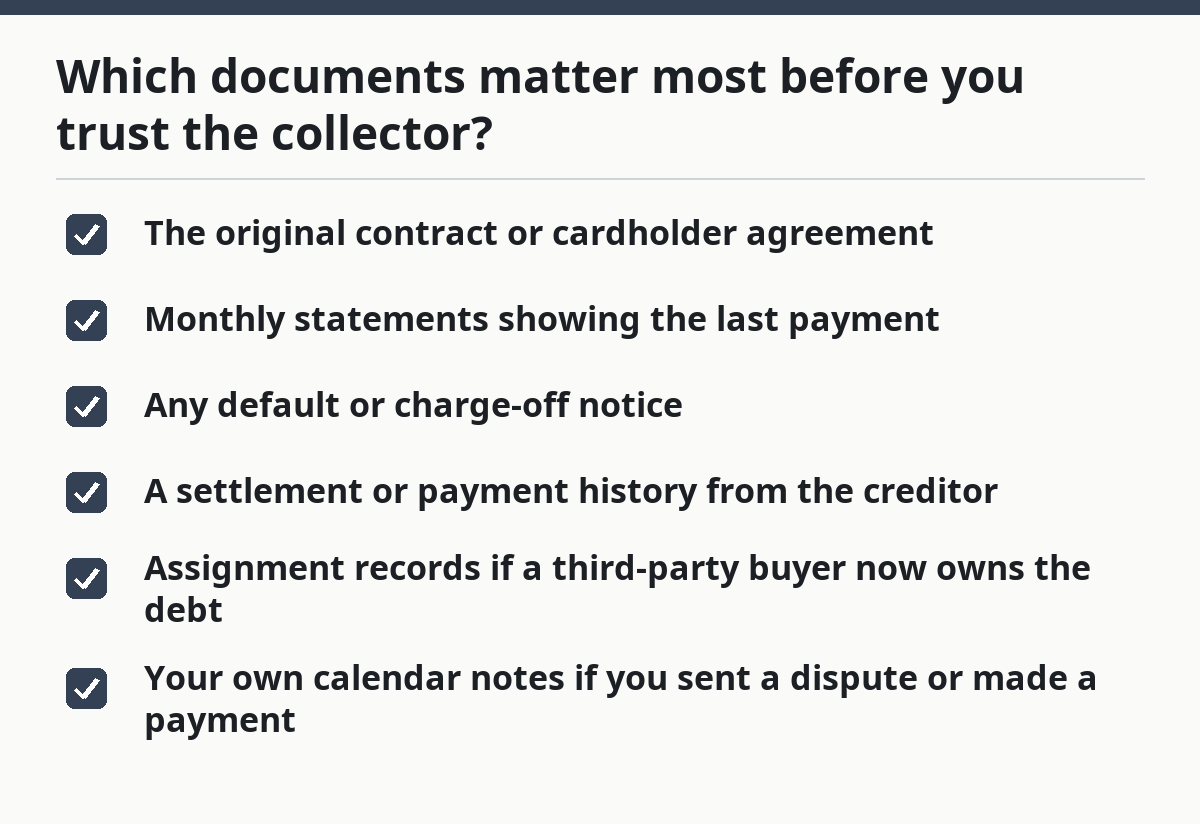
Which documents matter most before you trust the collector?
The documents matter because a collector’s letter is not the same thing as proof. You need the paper trail that links the balance to you and shows whether the deadline has passed.
Picture this: you have one notice on a 2023 form, but the alleged debt came from a 2018 account. The dates may matter more than the balance. Old debt cases often turn on a single date, not on how loud the collector sounds.
The most useful items are usually:
- The original contract or cardholder agreement
- Monthly statements showing the last payment
- Any default or charge-off notice
- A settlement or payment history from the creditor
- Assignment records if a third-party buyer now owns the debt
- Your own calendar notes if you sent a dispute or made a payment
The best part? You do not need a full legal brief to spot a weak file. You just need the right dates and the right names. If the collector cannot connect those two things, the claim is on shaky ground.
A debt validation letter is useful here because it forces the collector to state what it says you owe and why. It is not magic. It is a paper check. If the reply leaves out the original creditor, the amount breakdown, or the transfer chain, keep that gap in mind before you assume the debt is collectible.
When should you stop and get help?
You should stop doing this yourself when the debt could already be in litigation, when a court deadline is about to run, or when the facts are too messy to sort from the paperwork alone. Those cases can move fast.
Here are the situations that change the path:
You have been served court papers: The debt may already be in suit, and missing the answer deadline can cause a default judgment — get legal help right away.
The collector says you restarted the clock: A small payment or a written promise may change the limitation period in some states — verify the rule before you act.
The debt is tied to a judgment: A judgment is different from the original bill and often has its own collection period — check the judgment date, not the old account date.
Your state has a short deadline and the dates are close: A 3-year or 4-year limit can make timing tight — confirm the exact rule before you send money or letters.
The amount changes every time the collector writes: That can mean added fees, interest, or a bad file — ask for a full breakdown before treating it as collectible, and consider checking with a consumer law attorney or official state source.
You see a wrong identity match: Mixed files happen, especially with old accounts — stop and dispute if the address, Social Security number, or account history looks off.
If any of those apply, the problem is no longer just “Is this old?” It is “What is the legal effect if I act now?” That is where state-specific guidance matters most. A general article can’t safely answer that part for your case.
The mistakes people make with old debt
Old debt causes trouble because people confuse age with enforceability. A 7-year credit report rule is not the same thing as a lawsuit deadline, and that mix-up can cost time or money.
Picture this: you think the debt dropped off your credit report, so you assume it is dead. Or you send a $20 payment, and the collector says you restarted the clock. Those errors happen because the rules use different dates for different jobs.
Common mistakes include:
-
Using the credit report limit as the lawsuit limit.
Credit reporting and legal collection are different systems. The fix is to check the state statute of limitations, not just the credit bureau timeline. -
Ignoring the last payment date.
The last payment can matter more than the charge-off date. The fix is to verify the last qualifying activity in writing. -
Taking a collector’s word for the state deadline.
A collector may cite the wrong state or the wrong debt type. The fix is to confirm the rule on an official state source or with a qualified adviser. -
Sending money before asking for validation.
A partial payment can matter in some states. The fix is to demand debt validation first so you know what the payment could do. -
Assuming an old debt is harmless because it is old.
Old debts can still lead to calls, letters, or a lawsuit in some cases. The fix is to treat age as a clue, not proof, and get state-specific advice if the dates are unclear.
The correct move is simple: match the debt type, date, and state rule before you decide anything else. That is one way to know whether the debt is still legally collectible.
What if the usual rule does not apply?
The usual rule does not apply when the debt is a judgment, a tax debt, a child support obligation, or another category with special rules. Those cases use different deadlines and different collection tools.
Picture this: you find a 10-year-old court judgment, not a normal credit card bill. That changes the whole analysis. A judgment can last longer than the original account, and some states let creditors renew it under set procedures.
Use this checklist for edge cases:
- Judgment debt: Check the judgment date and any renewal paperwork. The collection period may be longer than the original account period.
- Charged-off but not sold debt: The original creditor may still own it, so the paperwork may be thinner. Verify who has authority to collect.
- Moved states: The law may turn on where the contract was made, where you lived, or where the suit is filed. Do not guess.
- Partial payment after years of silence: In some states, that can restart the clock. Verify the rule before you pay anything.
- Bankruptcy history: A discharge can block collection even if the debt once looked enforceable. Check the bankruptcy order before assuming anything.
On the flip side, if the file is a plain credit card debt, the state deadline is clear, and the collector cannot show a recent qualifying payment, the analysis is often much simpler. That is the kind of file a reader can sort with documents and a calendar.
For state-specific rules, the best sources are the state attorney general, state court self-help pages, or a consumer law attorney. The Federal Trade Commission’s debt collection page also gives a useful starting point on your rights: https://consumer.ftc.gov/articles/debt-collection-faqs
What a good result looks like
A good result is not “the debt is gone.” A good result is that you know which bucket it falls into: collectible, time-barred, or unclear.
Picture this: you have checked the dates, read the state rule, and asked for validation. Now you can see whether the collector has a viable claim or just an old account file. That clarity matters more than guesswork.
You want three things lined up:
- The debt type is identified correctly.
- The clock date is known and tied to the right state rule.
- The collector’s paperwork matches the balance and ownership claim.
If one of those pieces is missing, the answer is still incomplete. Stop there and fill the gap. A clean file can be reviewed in under an hour. A messy one can take longer, especially if the collector has sold the debt more than once.
For a broader map of how this decision fits into the rest of debt planning, see the hub on debt payoff decision rules and edge cases. This page handles the collectibility question.
How do I know if a debt is too old to collect?
A debt is too old to sue on when your state’s statute of limitations has passed for that debt type. The date that matters is usually the last payment, last charge, or another qualifying event under state law, not just the charge-off date.
Old does not always mean uncollectible. A collector can still ask for payment on a time-barred debt in many places, and the debt may still affect your records in other ways. The key is the lawsuit deadline, not the age alone. The FTC notes that collectors may still contact you about time-barred debt, but the collection rules vary by state.
Does a debt disappear after the statute of limitations?
No, a debt does not automatically disappear when the statute of limitations runs out. The deadline usually limits the collector’s ability to sue, but the underlying balance can still exist in records and may still be requested by mail or phone.
That is why the distinction matters so much. Time-barred debt and paid debt are not the same thing. If you need a state-specific read on the effect of the deadline, use official state guidance or a qualified adviser.
Should I pay an old debt?
An old debt can still be paid, but the right move depends on whether it is time-barred, who owns it, and whether a payment could reset the clock in your state. That last part is the trap.
If the debt is old and the file is unclear, do not send money before you know the legal effect. A partial payment can change the collector’s position in some states, so the safest first step is to confirm collectibility and ask for validation before any payment choice.
Drafted with AI; not yet reviewed by a person.