Last updated: November 20, 2026
If a debt collector leaves only a voicemail or a letter, the right move is usually to respond in writing, verify the collector, and save every message before you say anything about the debt. That keeps your collector follow-up organized and gives you a paper trail if the account, address, or contact details are wrong.
This is information, not financial advice. Debt collection rules vary by country and can change, so for your own situation, a qualified adviser or local consumer office can help.
Key takeaways
- Do not treat a voicemail or plain letter as proof that the debt is yours or that the amount is correct.
- Keep the first reply short, written, and dated so you can prove what happened later.
- Ask for the validation notice and check whether the collector’s name, address, and account details match.
- Certified mail gives you a delivery record, which matters if the collector later denies getting your reply.
- Stop and get qualified help if the contact looks wrong, the debt is old, or the letter leaves out basic identity details.
What should I do first?
You should save the message, check the sender, and avoid making any payment promise before you have the validation notice. A voicemail or letter can be the start of collection contact, but it is not enough by itself to tell you whether the debt is accurate, assigned to the right person, or within your rights to discuss.
Start with the basics from the FTC’s debt collection guidance and the CFPB’s debt collection page. Those pages explain core consumer rights and the validation process in plain language.
What matters most in the first 24 hours is control of the record. Write down the date, time, phone number, mailing address, company name, and the name used in the message, if there is one. Keep the envelope, too, because a postmark can matter if the dates do not match the letter.
If the voicemail gives only a first name, a callback number, or a vague threat, that is a warning sign. If the mail looks incomplete, has no return address, or does not identify the original creditor, the safest next step is still to ask for written validation before you engage further.
How do I follow up step by step?
You should follow up in writing, using a short, dated letter that asks for verification and keeps the conversation off the phone for now. The cleanest path is a paper trail, not a long explanation.
- Save the voicemail or letter for at least 12 months, and record the date, time, sender name, and callback number. Verify that the message actually names a debt collector and not a scam caller; if the details are missing, that is a problem.
- Match the mailed letter to the envelope and check whether it includes a validation notice. Verify the creditor name, account number, and mailing address; if those are absent or inconsistent, the contact needs more checking before you respond.
- Draft a short written reply of about 1 page that asks for validation and confirms the best mailing address for you. Verify that your name and return address are correct; if the letter includes payment instructions but no clear identity details, that is a red flag.
- Send the reply by certified mail, and keep the receipt and tracking number. Verify delivery, not just posting; if the tracking never updates or is returned, you may need to resend to a corrected address.
- Keep copies of everything in one folder: voicemail screenshot, letter, envelope, receipt, and your reply. Verify that each item is dated; if you cannot reconstruct the timeline in 2 minutes, the file is not organized enough.
- Wait for written validation before giving bank details, a payment plan, or a full story about your finances. Verify that the collector responds with documents that identify the debt; if the reply is only another demand for payment, the follow-up is incomplete.
- Compare the collector’s response with your own records and with the validation notice. Verify the amount, the original creditor, and the collector’s authority to collect; if the numbers or names do not line up, stop and ask for clarification in writing.
- Escalate to a qualified adviser or consumer agency if the collector ignores your written request or keeps calling after you asked for written contact only. Verify whether your local rules give you extra rights; if you are unsure, do not guess from a template online.
That process is slower than a phone call, but it gives you evidence. It also reduces the chance that you say something inaccurate about a debt you have not yet checked.
What should the letter say?
Your letter should ask for validation, not argue the whole case. A tight letter of 4 short paragraphs is enough: identify yourself, say you received a voicemail or letter, request written validation, and ask for future contact in writing.
Do not put in a long explanation of hardship, blame, or a promise to pay later unless you are ready for that conversation. In a debt file, extra words can create extra disputes. The cleaner the letter, the easier it is to compare against the collector’s response.
If you send the letter by certified mail, keep the proof of mailing with the copy of the letter. That matters because phone logs can disappear, but a receipt and tracking record can show that you acted within days, not months.
A simple structure looks like this:
- Your full name and current mailing address
- Date
- Collector’s name and mailing address
- One sentence saying you received a voicemail or letter
- One sentence asking for debt validation and account details
- One sentence asking for written contact only for now
- Your signature
If you want to include one line about your phone number, keep it to the number you actually want used. Do not give extra contact details unless you mean to open more channels.
How do I check whether the collector is real?
You should verify the collector by matching the name, address, and account details against the validation notice and the mailing information. A real collector should be able to identify itself clearly enough for you to tell who is contacting you and what debt it claims to own or service.
A voicemail alone is the weakest form of contact. It may be enough to tell you someone is trying to reach you, but not enough to prove the debt, the collector’s authority, or the current balance. A letter is better, but only if it includes enough detail to connect the notice to a real account.
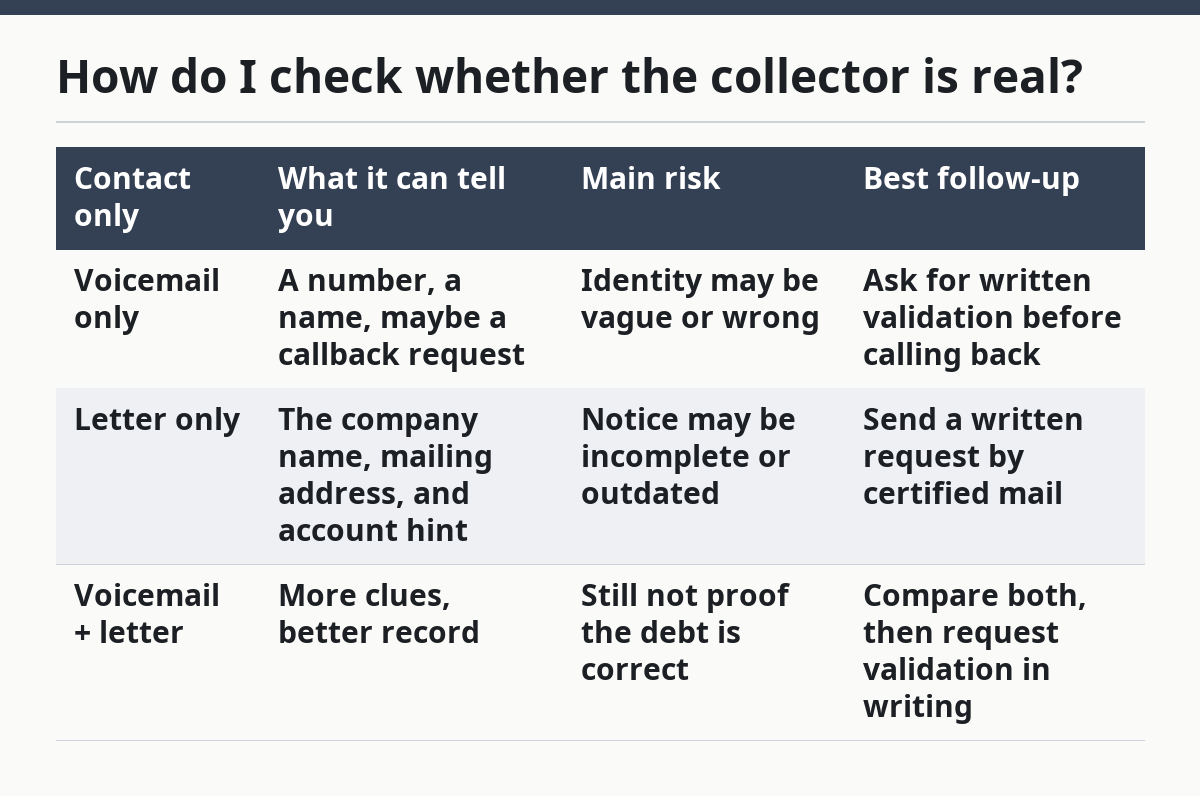
Here is a quick comparison:
| Contact only | What it can tell you | Main risk | Best follow-up |
|---|---|---|---|
| Voicemail only | A number, a name, maybe a callback request | Identity may be vague or wrong | Ask for written validation before calling back |
| Letter only | The company name, mailing address, and account hint | Notice may be incomplete or outdated | Send a written request by certified mail |
| Voicemail + letter | More clues, better record | Still not proof the debt is correct | Compare both, then request validation in writing |
If the collector refuses to put basics in writing, that is not a small issue. It makes it harder to verify the debt and harder to prove what was said later.
When should I stop and get help?
You should stop the standard follow-up and get qualified help when the contact is incomplete, confusing, or starts to affect your rights. This is a money issue, so if something feels off, do not guess.
The voicemail gives no company name: that means you cannot confirm who is contacting you — do not call back until you get a name and mailing address in writing.
The letter has no validation notice: that means the collector may not have given the basic information you need — request the notice in writing and keep the envelope.
The address or account details do not match your records: that means the contact may be aimed at the wrong person or the wrong debt — pause and ask for a corrected written notice.
The collector keeps calling after you asked for written contact only: that means your paper trail may matter more than a phone conversation — save each message and consider outside help.
You feel pushed to pay before you understand the balance: that means you do not yet have enough information to make a sound decision — do not give bank details or a payment promise yet.
The debt seems old, but you are not sure how old: that means age may be an issue under local rules — get local guidance before you admit anything in writing.
If the collector is already threatening legal action, garnishment, or similar steps, stop treating this as a routine follow-up. That is the point where local consumer law help can matter more than a template letter.
What mistakes do people make with voicemail or mail?
People most often make the mistake of replying too fast, and that can cost them control of the paper trail. A short, careful reply is better than a long phone call when you have only voicemail or mail to go on.
- Calling back first: this can pull you into a live script before you have the facts, and you may say more than you mean to. The better move is a written request for validation.
- Paying from a voicemail link or callback number: this can lead to paying the wrong party or sending money before the debt is verified. Use the mailing address on the written notice instead.
- Throwing away the envelope: that removes postmark evidence and can break the timeline if the date matters later. Keep the envelope with the letter.
- Ignoring the message completely: this can let a real account age without your response, and it may also let a wrong contact go uncorrected. A short written reply protects you more than silence.
- Arguing about the debt by phone: this often turns into a messy record with no clean proof of what was said. Written communication keeps the facts in one place.
- Sending payment without checking the notice: this can create confusion if the collector is not the current owner or servicer. Validate first, then decide.
The common thread is simple: voicemail and mail are clues, not proof. Treat them like the start of a file, not the end of one.
When does the usual approach change?
The usual approach changes when the message is incomplete, when the address is wrong, or when the collector is not the party you expected. In those cases, the first job is not payment; it is identity and record control.
If the letter is clearly a validation notice, you can reply in writing with a focused request and keep the process narrow. If it is just a vague demand letter, ask for the missing details before you discuss anything else. If the voicemail says to call back “today,” do not let that urgency replace verification.
There is also a practical difference between a single message and repeated contact. One voicemail may be a mistaken or old number; repeated messages may mean the collector has your file actively open. In either case, the response should stay in writing until the account details are clear.
This page sits under the broader debt payoff communication and hardship hub, but this article stays focused on passive contact only. It does not cover live-call scripts, payment plans, or hardship decisions.
How long does this take?
This process can take just a few days to start and longer to finish, depending on how quickly the collector replies in writing. The first hour is usually enough to save the message, check the notice, and prepare a short letter.
A good result looks like this: you have the voicemail or letter saved, you have sent a written request, and you can show the date you mailed it. The collector either sends a usable validation response or stops pressing you for immediate action.
A bad result is more chaotic: you called back, gave details, lost the envelope, and no longer know what was said. That is avoidable, and it is why the paper trail matters more than speed.
What if the only contact I have is a voicemail or letter?
You should treat that as enough to start, but not enough to settle anything. A voicemail or letter is usually the trigger for written follow-up, not the place to solve the debt.
If you have only a voicemail, save it and reply in writing to the callback address or mailing address if you can find it. If you have only a letter, keep it intact and send your own request by certified mail so you can prove delivery. In both cases, the point is the same: put the collector on paper before you talk money.
Do I have to call back a debt collector?
No, you do not have to call back just because you got a voicemail. A written reply is usually the safer first step because it creates a record and gives you time to check the notice. If the voicemail lacks a clear company name or address, do not return the call until you can verify who sent it.
Should I reply in writing instead of by phone?
Yes, writing is usually better when all you have is voicemail or mail. A letter gives you proof of what you asked for and when you asked for it, which helps if the collector later changes its story. Phone calls can be useful later, but written contact is the cleaner first move.
What if I only have a voicemail or letter?
Use that contact as the starting point for verification, not as proof of the debt. Save the message or letter, check the name and address, and send a short written request for validation by certified mail if possible. If the message is vague or incomplete, pause before giving any personal or payment information.
Drafted with AI; not yet reviewed by a person.