Last updated: November 20, 2026
Choose the debt payoff method you can follow for 6 to 12 months without stalling out. For most people, the right plan is the one that matches how they stay motivated, track progress, and handle boring routines; this is information, not financial advice, and a qualified adviser should review your own situation.
Key takeaways
- Pick the plan you will actually repeat after the first excited week ends.
- If quick wins keep you going, a visible progress plan may fit better than a purely math-first one.
- If lower interest is what keeps you disciplined, a method built around the numbers may suit you better.
- A hybrid payoff method can work when one style alone feels too rigid.
- If minimum payments are all you can manage right now, the first job is to stop the plan from collapsing.
Who should use a debt payoff method by psychological fit?
This approach is for someone who already knows the debt list, the minimum payments, and the rough order of the balances, and now needs a plan that they can stick with for more than 1 month. It is not about picking the “best” method in theory; it is about choosing the one that fits your brain on an ordinary Tuesday.
The main methods people compare are the debt snowball, the debt avalanche, a hybrid payoff method, and paying only minimum payments on everything while you sort out the next step. The first two are full payoff strategies; the hybrid method mixes parts of both; minimum payments are the floor, not a finish line.
This guide is for readers who want to think about motivation style, discipline versus momentum, and progress tracking before they choose. It is not for someone who is in a 2-day crisis and needs emergency legal or budgeting help, or for someone who already has a formal plan from a qualified adviser and should not improvise over it.
How do I choose the right debt payoff method step by step?
Choose the right debt payoff method by matching the plan to the way you actually behave, then checking whether the math still works with your budget. The process is simple, but each step matters because a plan that looks neat on paper can still fail if it feels punishing.
- List every debt, the minimum payment, and the balance on one page, then verify that no account is missing and no due date is unclear; a missing balance is a sign the plan is too vague to trust.
- Rank how you stay motivated by asking whether you need quick wins, visible debt shrinkage, or a lower total interest path; if you cannot answer in one sentence, the plan is probably too abstract.
- Test the debt snowball against your personality by asking whether knocking out a small balance would give you enough energy to keep going; if a small win feels emotionally powerful, this method may fit.
- Test the debt avalanche against your personality by asking whether saving interest is what keeps you focused; if you only care when the numbers improve, the math-first route may fit better.
- Try a hybrid payoff method on paper by combining one small balance for motivation and one high-interest balance for discipline; if the mixed order feels confusing after 1 minute, the hybrid may be too fiddly for daily use.
- Check your tracking habit by choosing one place to record progress, such as a notebook, spreadsheet, or app, and verify that you can update it in under 5 minutes; if tracking feels like homework, the system is too complicated.
- Compare your emotional reaction to minimum payments with your reaction to a full payoff target; if minimum payments make you feel stuck and angry, you need a clearer next action than “just keep paying.”
- Decide on one method for 3 months, then review whether you missed payments, skipped updates, or lost interest; if the plan already feels impossible in week 2, the fit is wrong, not your willpower.
The goal is not perfection. The goal is a method that survives real life: a late bill, a tired evening, and a month when motivation drops to zero.
Which method matches my motivation style?
The method that fits best is usually the one that matches what keeps you moving when the first burst of enthusiasm fades. Some people need a visible win; others need a clean spreadsheet and a reason to stay strict.
| Method | Best psychological fit | Main strength | Main drawback |
|---|---|---|---|
| Debt snowball | You need momentum and quick wins | Small balances disappear faster, which can feel rewarding | You may ignore the interest math for longer |
| Debt avalanche | You stay committed when the numbers are efficient | The order is driven by the highest interest cost | Progress can feel slow if your biggest debt is large |
| Hybrid payoff method | You want a blend of emotion and logic | It can balance motivation with discipline | It adds one more decision rule |
| Minimum payments only | You need a short pause while you stabilize | It keeps accounts current for the moment | It does not reduce debt fast and can feel discouraging |
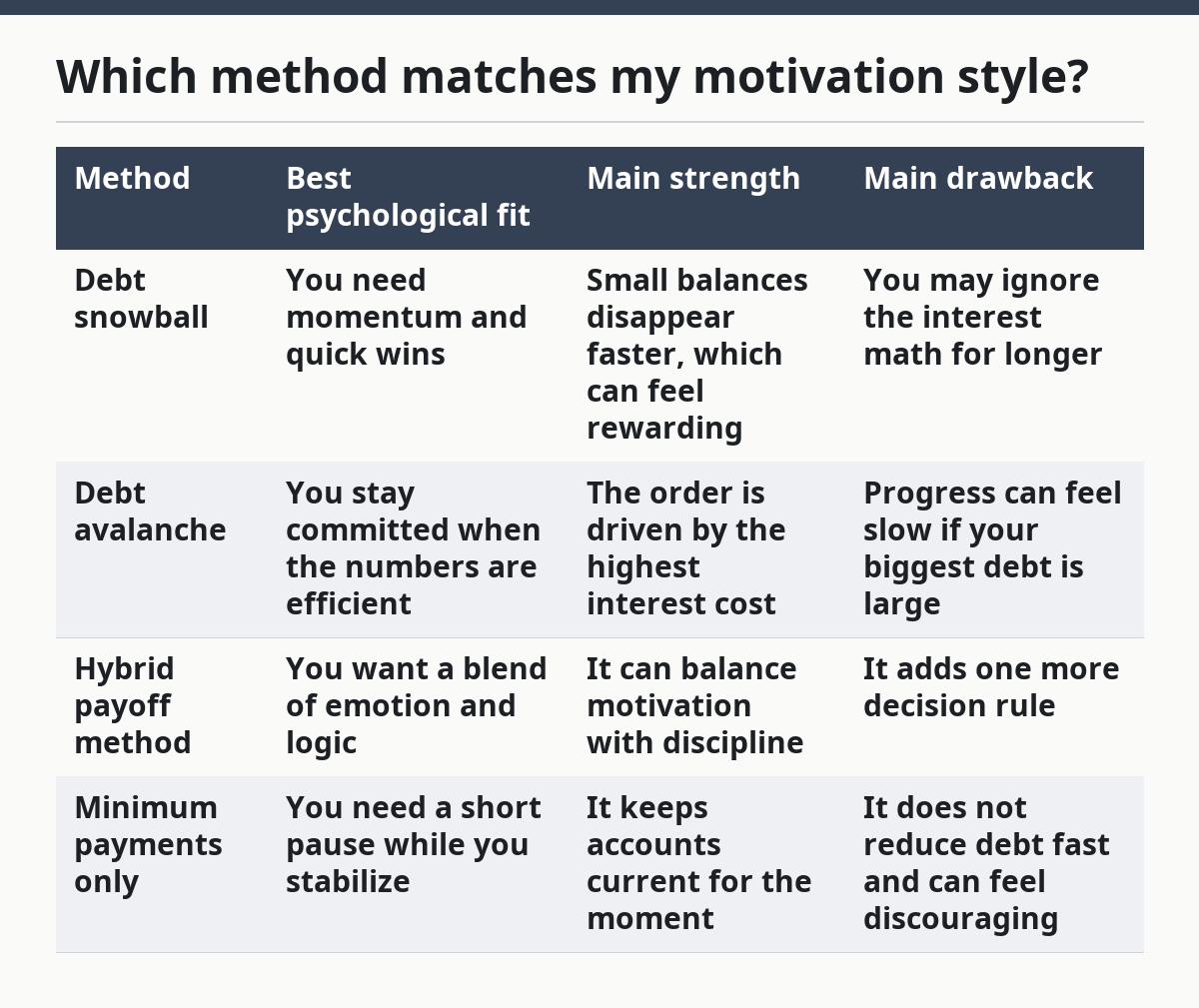
If you are energized by crossing items off a list, the debt snowball often feels easier to repeat. If you are motivated by clean logic and dislike doing things “out of order,” the debt avalanche may feel more natural. If both styles matter to you, a hybrid payoff method is often the middle ground, but only if you can describe the rule in one plain sentence.
The wrong fit shows up fast. If you keep changing the order every week, the method is too complicated. If you never start because the plan feels emotionally flat, the method is too cold for your temperament.
What should I check before I commit?
Check whether the method matches your attention span, your budget habits, and your tolerance for slow progress before you lock it in for 3 months. A plan that looks smart but gets ignored is worse than a simpler plan that survives.
First, look at your tracking style. If you can update a balance chart once a week without dread, that is a good sign. If a spreadsheet makes you avoid the whole topic, choose a method with fewer moving parts and one visible target.
Second, check your reaction to minimum payments. For some people, minimum payments feel like a manageable floor that buys time. For others, they feel like standing still, and that feeling makes them quit. If standing still makes you lose momentum, the method should give you a faster milestone.
Third, check how you respond to delay. Some people can wait 6 months to see a major result; others need a small win every few weeks. If you need frequent proof that the plan is working, a payoff order with visible progress matters more than pure math.
When should I stop using this approach?
Stop using a psychological-fit method when the plan starts causing missed payments, constant re-ordering, or so much stress that you cannot follow it for 1 full month. That usually means the method is the wrong tool, not that you failed.
You keep changing the order every 7 to 14 days: the plan is asking for too many choices — simplify it to one rule and review it only once a month.
You cannot track progress in under 5 minutes: the system is too heavy — switch to a simpler tracker or fewer accounts in the active plan.
You feel no pull from any milestone: the method is not giving you momentum — pick a plan that makes the next win more visible.
You are only paying minimum payments and nothing is changing: the debt is not being reduced in a way that feels meaningful — you need a clearer payoff target or outside help from a qualified adviser.
Your budget changed and the plan no longer fits: the old method may be outdated — pause the payoff order and rebuild it around the new monthly number.
If any of these situations point to a larger money problem, such as repeated missed bills or debt you cannot organize on your own, qualified help is the better next step. The method should reduce friction; if it adds it, it has stopped doing its job.
What mistakes do people make with debt payoff methods?
People usually make the same 4 mistakes: they choose a method for pride, not behavior; they ignore tracking; they change plans too often; and they confuse “best in theory” with “best for me.” Each one costs time and usually a lot of motivation.
Choosing the most logical method is a common trap. If you hate the process, you will delay it, and a delayed plan does not beat a less efficient plan that gets followed for 12 months. The better choice is the one you can live with on ordinary days.
Ignoring tracking is another mistake. Without a weekly check-in, you cannot tell whether the method is helping or whether you are just making payments at random. A simple notebook, calendar, or spreadsheet is enough if you actually use it.
Changing plans after one bad week is also a problem. Most payoff methods need time to show a pattern, and a single off month does not prove the method failed. The fix is to review on a set date, not whenever you feel discouraged.
Finally, people sometimes choose a plan because it sounds disciplined. Discipline matters, but if the method makes you resent every payment, the resentment can wipe out the benefit. A slightly less perfect plan that you can repeat is usually better than an ideal one you quit.
Can I mix debt payoff methods?
Yes, you can mix debt payoff methods if the rule is simple enough to explain in one sentence. A hybrid payoff method works best when one part of the plan helps your emotions and another part keeps the math honest.
A common problem with hybrids is overcomplication. If the rule needs a long explanation every time you pay, the method is too hard to maintain. The cleaner the rule, the better the odds that you will keep using it for the next 6 months.
Mixing methods is most useful when one style alone leaves you cold. If quick wins keep you from quitting but interest cost still matters to you, a hybrid payoff method can bridge the gap. If the mix makes you second-guess every payment, go back to a single rule.
How do I know which debt payoff method I’ll stick with?
You know by asking which plan you can repeat after the novelty wears off. If a method still sounds acceptable after 2 or 3 practice runs on paper, it is more likely to last.
The best clue is your reaction to boring repetition. If you want visible progress, the debt snowball may feel easier to sustain. If you prefer one clean rule and do not mind delayed payoff milestones, the debt avalanche may fit better. If both answers are partly true, a hybrid payoff method may be the closest fit.
Can I mix debt payoff methods?
Yes, if the rule stays simple and you can explain it without a script. A hybrid payoff method can help when pure logic feels too dry or pure motivation feels too loose.
The risk is confusion. If you keep adding exceptions, the plan becomes harder to follow than either standard method, and that usually hurts follow-through.
What matters more: interest savings or motivation?
Motivation matters more if you are likely to quit, and interest savings matter more if you are steady enough to keep going. The better choice is the one that keeps payments consistent for months, not the one that looks smartest on day one.
If you are torn, use the method that makes you act. A plan that gets followed is more useful than a perfect one that stays in a note app.
Drafted with AI; not yet reviewed by a person.