Last updated: November 20, 2026
A fee waiver request works best when you ask for one specific fee to be removed, explain the reason briefly, and point to a clean payment history or a one-time mistake. If you want a late fee waived without asking for a payment plan, keep the request narrow: ask for the fee reversal only, not a change to the debt itself.
This is general information, not financial advice; your own situation may need a qualified adviser.
Key takeaways
- Ask for the fee to be removed, not for the account to be reshaped.
- Keep the reason short, factual, and tied to your account history.
- A good request names the exact fee, the date, and the account number.
- Phone, chat, and written requests can all work, but written proof helps if the fee stays.
- If the account already has a pattern of missed payments, the waiver is less likely and the request needs more care.
Who should use this approach?
This approach fits a person who wants a one-time fee reversal and does not need a payment plan, a due-date change, or a hardship setup. It also fits someone with a late fee, a returned-payment fee, or another account fee that was triggered by one event rather than ongoing trouble.
It assumes you already know the creditor’s name, the account number, the fee amount, and the date the fee hit the account. It also helps if you can point to payment history, such as several on-time payments before the fee, because that gives customer service a reason to review the charge.
This is not the best tool if you already know you need more time to pay, if the account is in collections, or if you need to explain a larger hardship. Those situations call for a different message, often in writing, and a fee-only request can be too small for the problem. A fee waiver request is narrow by design, and that narrowness is what makes it useful.
How do I ask for a fee waiver?
You ask by naming the fee, asking for a reversal, and keeping the message short enough for customer service to handle in one review. The most effective version is plain and direct: “Please waive the late fee on account ending in XXXX from [date]. I have a strong payment history and would like a one-time courtesy adjustment.”
Use these steps in order.
- Gather the account number, fee date, fee type, and one recent example of payment history, then verify the fee is actually on the statement or online account; if the fee date or amount is wrong, stop and fix that first.
- Check the account terms for the fee name and any reversal language, then verify whether the creditor allows one-time waivers; if the fee is not listed or the charge is duplicated, that is a dispute issue, not a courtesy request.
- Choose one contact channel, such as phone, secure message, or written letter, and verify the creditor has the right customer service line or address; if you reach a sales line or a third-party collector, the request may not land with the account holder.
- Write a 3- to 5-sentence script that asks only for the fee reversal, then verify it includes the exact fee, the date, and a brief reason; if your draft starts asking for more time, more changes, or a new schedule, it is no longer a fee-only request.
- State the reason in one sentence, such as a one-time oversight, a billing delay, or a short-term timing issue, then verify you are not overexplaining; if the story becomes long or inconsistent, the representative may treat it as a bigger account problem.
- Ask customer service for a case number or reference number, then verify the representative says the fee will be reviewed or reversed; if you get only a vague “we’ll note it,” ask for the next step before ending the call.
- Confirm the outcome in the same channel if possible, then verify the fee disappears from the online account or next statement; if the fee remains after the promised review period, send a follow-up that repeats the original request once and attaches the first reference number.
- Save screenshots, letters, and notes about the call, then verify the record shows the date, time, and name or ID of the representative; if the charge reappears later, those notes help show what was promised.
A simple script can sound like this: “I’m calling about the late fee on account ending in 1234. I’m asking for a one-time fee waiver based on my payment history, and I’m not requesting a payment plan. Can you review the fee reversal and let me know if it can be removed?” That version is short enough for customer service and specific enough to be tracked.
For general consumer rights on billing disputes and credit reporting, the Consumer Financial Protection Bureau has plain-language material on bills and account review: CFPB. The Federal Trade Commission also explains how to handle billing errors and keep records: FTC.
What should I include in the message?
You should include the fee name, the date it posted, the account number, and one reason the creditor can say yes without changing the payment schedule. Those details make the request easy to route, and they also keep you from drifting into a hardship explanation the creditor did not ask for.
A useful message has four parts. First, identify the account. Second, name the fee exactly, such as “late fee” or “returned payment fee.” Third, ask for a courtesy waiver or fee reversal. Fourth, give one short reason, like a clean payment history or a one-off mistake.
Do not attach a long budget story unless the creditor asks for it. A fee waiver request is not the place for income figures, expense lists, or a promise to pay later. That kind of detail can pull the conversation toward a payment arrangement, which is a different request and a different review path.
If you are writing instead of calling, keep the letter to one page. A short letter is easier for customer service to process than a full explanation, and the shorter version is less likely to wander into topics you do not want to raise.
Phone or writing: which works better?
Writing is better when you want a record, and phone calls can work faster when the fee is small and the account is current. The best choice depends on whether you need proof more than speed.
| Method | Best for | Strength | Drawback |
|---|---|---|---|
| Phone | Quick request for a late fee waiver | Immediate answer or escalation | Harder to prove later |
| Secure message | Accounts with online portals | Written record inside the account | May take longer than a call |
| Letter | Formal fee reversal request | Strong paper trail | Slowest option |
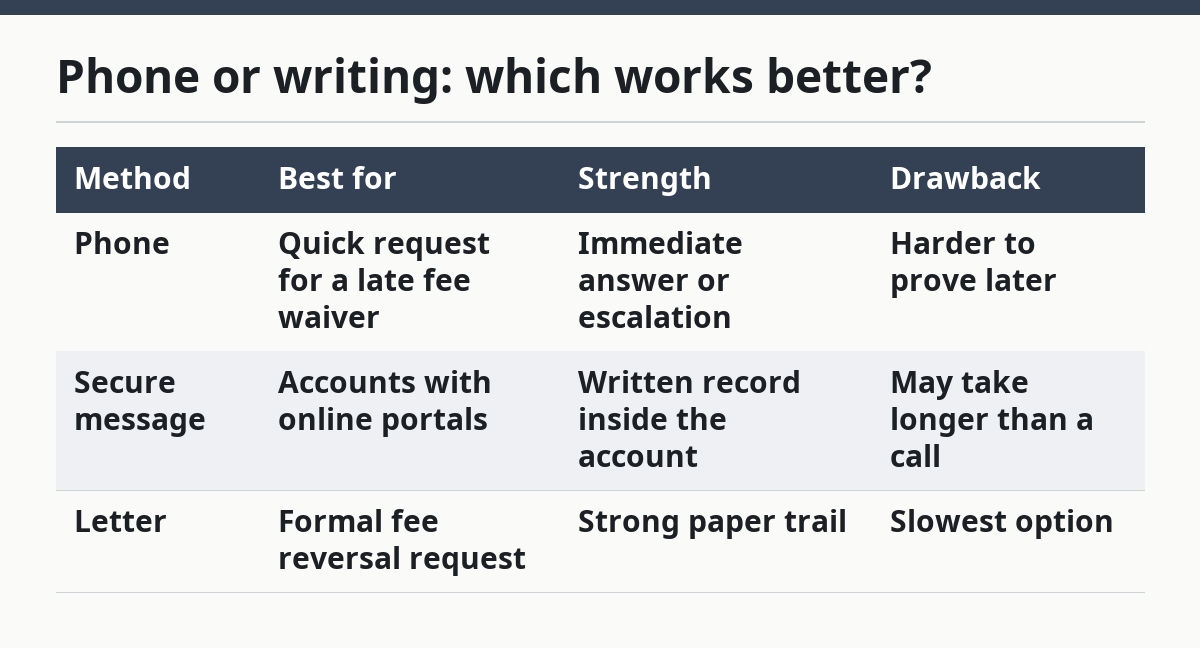
A phone call is useful when you want a quick yes or no on a single fee. A written message is better when the first answer is no, when the fee is large, or when you expect a follow-up review. If the creditor says the fee can only be reviewed in writing, switch channels right away instead of repeating the same call.
When should I stop and try something else?
You should stop this approach when the fee is not the real problem, or when the account needs a different kind of review. A fee-only request is narrow, and forcing it into a larger money problem usually weakens the result.
The account is already in collections: the original creditor may no longer control the fee — contact the current debt holder or collector and ask who can review the charge.
The fee is part of a wider billing error: a waiver request is not enough if the bill itself is wrong — ask for a billing dispute and keep the fee request separate.
You have already asked for the same fee twice: repeated requests can stop looking like a one-time courtesy — gather new facts or ask for escalation.
The representative starts discussing a payment plan: the conversation has shifted away from fee reversal — restate that you want only the fee reviewed.
The account history shows repeated missed payments: a courtesy waiver is less likely to be granted — prepare for a denial and decide whether you still want to ask in writing.
The fee came from a returned payment or processing error you do not understand: you may need the transaction details first — request the fee explanation before asking for the waiver.
These situations do not mean a fee waiver request is impossible. They mean the clean, narrow version of the request is probably the wrong tool, and a broader account review may be needed instead.
What mistakes cost people the waiver?
The biggest mistake is asking for too much in the first message. A request that asks for a fee waiver, a due-date change, and “some breathing room” in one breath often gets routed as a hardship request instead of a simple reversal.
Another common mistake is being vague about the fee. Saying “please remove the charge” gives customer service too little to verify. Naming the fee, date, and amount makes the request actionable and reduces back-and-forth.
A third mistake is apologizing too much or overexplaining. Long stories can bury the request, and they sometimes make the issue sound less factual. A short reason, tied to the account history, is stronger than a paragraph of background.
A fourth mistake is ending the call without a reference number. If the fee is not removed right away, you need a record of the first request. Without that number, a follow-up can turn into a fresh call with no trace of the original conversation.
A fifth mistake is forgetting to check the next statement. Some creditors reverse the fee after the call, while others post the credit a cycle later. If you do not verify the change, the charge can sit on the account unnoticed.
What if the creditor says no?
If the creditor says no, ask once for the reason and then decide whether a written follow-up is worth it. A denial is not always the end, but a second ask should bring something new, such as a different contact channel, clearer payment history, or a correction to the account record.
If the fee was supposed to be reversed as a courtesy and never was, a brief follow-up can still work. If the denial is tied to repeated missed payments, the answer may stay no, and pushing harder can waste time. In that case, the better move is to keep the note for your records and focus on the next statement.
How do I keep the request clean?
You keep it clean by asking for one fee, one action, and one result. That means “waive this late fee” or “reverse this returned-payment fee,” not “fix my account.”
A clean request also uses the same words across the phone call, message, and follow-up note. If you start with “fee waiver request,” then shift to “temporary help” or “payment relief,” the creditor may think you want a plan after all. Consistency matters because customer service systems often sort calls by keywords and account notes.
FAQ
Can I ask a creditor to remove a fee?
Yes, you can ask a creditor to remove a fee as a courtesy or as a fee reversal. The request is strongest when it names the fee, the date it posted, and the account history that supports the ask. A late fee is the most common example, but the same structure can work for other account fees.
What should I say when I want a fee waived?
Say that you are asking for a one-time fee waiver and want only the fee reviewed. Keep the script short: identify the account, name the fee, and give one brief reason tied to payment history or a one-time issue. If you add requests for payment changes, the conversation may turn into a different case.
Do fee waiver requests work better by phone or in writing?
A phone call can get a faster answer, but writing gives you a record. If the fee is small and you want a quick review, phone is often the faster route. If the fee is denied, if you want proof, or if the first contact does not resolve it, follow up in writing and save the reference number.
Drafted with AI; not yet reviewed by a person.