Last updated: November 20, 2026
Quick answer: there are 2 main DMCA paths to think about here — takedown and anti-circumvention — and the right one depends on the facts. If the question is about copyright complaints, the safest short answer is that the DMCA is not a blanket ban on reuse; it has narrow exceptions, and Congress also passed the CASE Act in 2020, which created the Copyright Claims Board. For the statutory framework, see the Copyright Office’s DMCA overview and 17 U.S.C. § 1201.
Key takeaways
- The DMCA does not answer every copyright question in the same way. Some uses fall into narrow exceptions, while others can still trigger a complaint.
- Congress passed the CASE Act in 2020, and that created the Copyright Claims Board.
- Circumvention is only allowed in limited cases, such as short motion-picture portions for criticism or comment, and in some supervised educational settings. See 17 U.S.C. § 1201 and the Copyright Office’s exemptions page.
- If a badge has been installed and registered for at least 30 days, it may qualify for a free standard copyright takedown according to DMCA.com.
- Standard managed takedowns include a money-back guarantee on qualifying cases according to DMCA.com, but that does not erase the need to check whether the claim itself is valid.
What is the DMCA actually for?
The DMCA is for copyright disputes where someone wants to remove or challenge online material, but it does not settle every copyright problem by itself. A lot of people search the DMCA after seeing a notice, and the real question is usually whether the material can be taken down, defended, or covered by an exception.
Therefore, that is where the first trap appears: people treat the DMCA like a universal yes-or-no test. It is not. There are limited situations where circumvention is allowed, and there are also cases where a complaint can still move forward in the U.S., including the complaint filed by IO Group, Inc. against Veoh Networks, Inc. on June 23, 2006.
The practical point is simple. If a reader is trying to copy, remove, repost, or defend material, the DMCA question is not “Is it legal in general?” The better question is “Which rule applies here, and is this one of the narrow exceptions?”
When does circumvention count as allowed?
Circumvention is allowed only in narrow situations, and that is the part most people miss. One of the listed exceptions is the use of short motion-picture portions for criticism or comment in limited instances, and the list also includes supervised educational purposes. See the Copyright Office’s exemption rules and 17 U.S.C. § 1201.
That means the DMCA does not treat every locked file, clip, or protected segment the same way, so readers should consult a professional if the facts are close. A short clip used to comment on the clip itself is not the same thing as copying a full work and calling it commentary. The difference matters because the exception is narrow, not broad.
The trade-off is obvious. The exception helps people who need a small excerpt for real criticism or classroom use, but it does not give a free pass for broad reuse. If the use is larger than the exception, or if the use is not really criticism, comment, or supervised education, the safer assumption is that the exception may not apply.
This is also where many generic articles get lazy. They make the DMCA sound like one rule for everyone. It is not. The exception is specific, and the specific part is the whole point.
What changed when the CASE Act passed?
The CASE Act changed the copyright landscape in 2020 by creating the Copyright Claims Board within the U.S. That matters because people often ask whether the DMCA is the only route for a copyright problem, and the answer is no.
The DMCA is one tool, but not the only legal structure people now talk about in copyright disputes. The Copyright Claims Board gives the system another path, which means a person who thinks only in terms of takedowns can miss the bigger picture.
That said, the CASE Act does not make every dispute simpler. It adds another process, not a magical fix. The useful takeaway is that the U.S. copyright system now has more than one place where a dispute can go, so the first question should be which forum fits the problem.
If the issue is a takedown request, the DMCA still matters. If the issue is a broader copyright claim, the CASE Act can matter too. Those are related questions, but they are not the same question.
Which takedown path makes sense?
The better choice depends on whether the claim is already organized or still needs help. A free standard copyright takedown may qualify if a badge has been installed and registered for at least 30 days, according to DMCA.com. Standard managed takedowns also include a money-back guarantee on qualifying cases, according to DMCA.com.
| Criteria | Free standard copyright takedown | Standard managed takedown | Winner for [condition] |
|---|---|---|---|
| Entry requirement | May qualify if a badge has been installed and registered for at least 30 days, according to DMCA.com | Designed as a managed option | Free standard copyright takedown for a qualifying badge setup |
| Cost signal | The service is described as free for qualifying cases | Includes a money-back guarantee on qualifying cases, according to DMCA.com | Free standard copyright takedown when eligibility is clear |
| Help level | More self-directed | More guided | Managed takedown when the case needs more support |
| Fit for simple claims | Strong fit | Can be more than needed | Free standard copyright takedown |
| Fit for uncertain claims | Limited | Better fit | Standard managed takedown |
| Risk of paying for extra handling | Lower if eligible | Higher commitment in structure, even with the guarantee | Free standard copyright takedown |
| Confidence in qualifying cases | Good if the 30-day badge condition is met | Good if the case qualifies for the guarantee | Tie, depending on setup |
| Appeal for difficult cases | Less flexible | More flexible | Standard managed takedown |
| Main drawback | Requires the badge and registration condition | Not the simplest route for every case | Managed takedown only when the extra help is worth it |
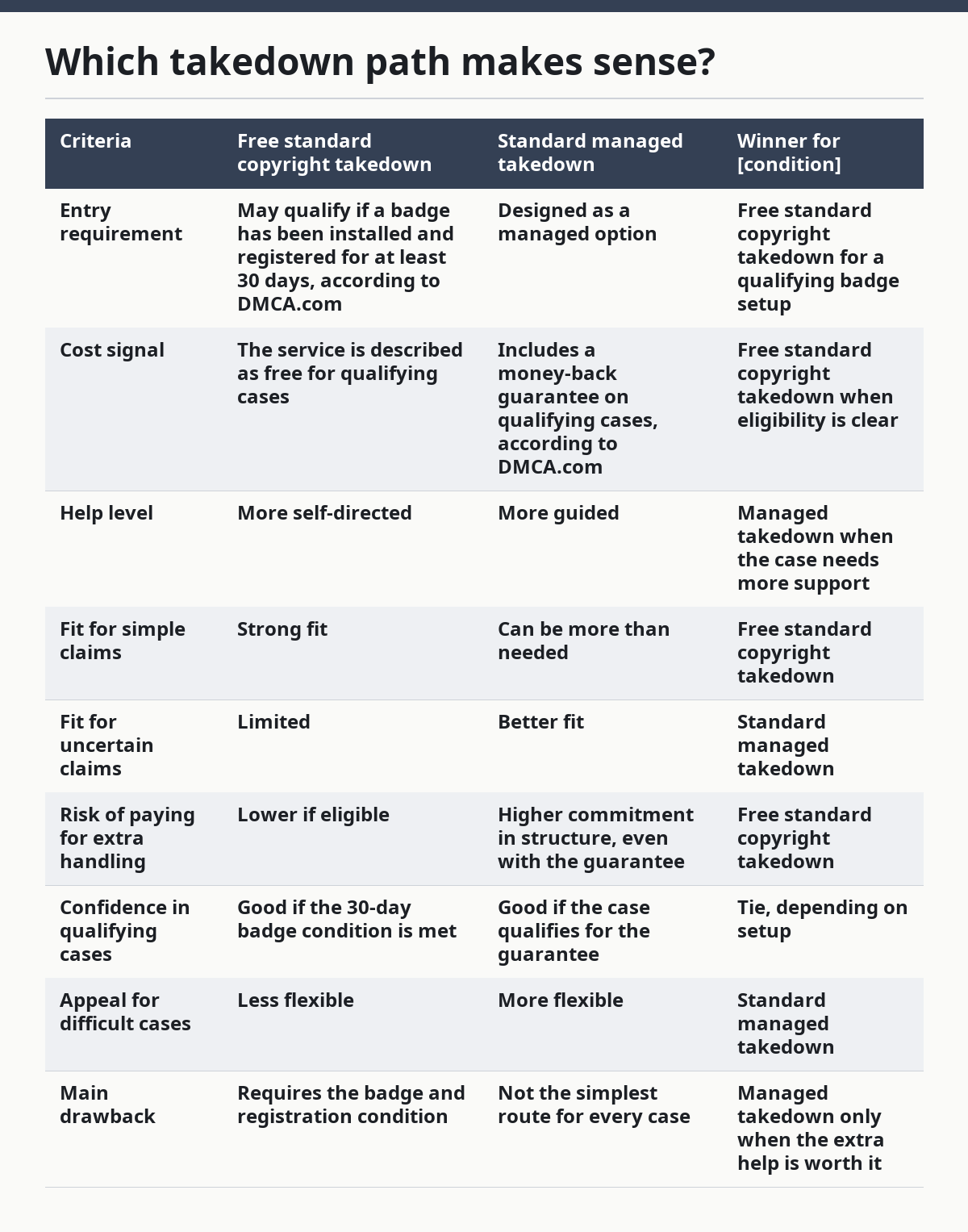
Therefore, the free standard route wins when the badge condition is already met and the claim is straightforward. The managed route wins when the case is less tidy and the reader wants a structured process with a guarantee on qualifying cases.
The honest drawback is that neither option is a substitute for checking the actual facts of the claim. A takedown path can only help if the underlying complaint belongs in that path. If the issue is really about fair use, a narrow exception, or a different copyright forum, the takedown choice may be the wrong first move.
What do people usually get wrong about DMCA complaints?
People usually get wrong the idea that a DMCA complaint and a copyright dispute are identical, but they are not. The complaint in the Veoh matter was filed in the U.S., and the district court found that the defendant knew users were infringing and failed to prevent future infringement.
That example shows why surface-level questions can mislead. A reader may think the only issue is whether something was posted online. The deeper issue is whether the facts suggest infringement, knowledge, or failure to stop future infringement.
So the practical mistake is to ask, “Can I just file a takedown?” without asking, “Do the facts support the claim, and is this one of the narrow exceptions?” That second question matters just as much. A fast complaint can still be a weak complaint if the underlying use falls into criticism, comment, or supervised educational use.
The other common mistake is to think a single quote, clip, or file fragment tells the whole story. It does not. In copyright work, context is the part that changes the answer.
When should I think again before filing or relying on one?
I should think again if the use is one of the limited circumvention exceptions, if the material was used for supervised education, or if the dispute is really broader than a takedown. Those are the cases where a quick DMCA answer can be the wrong answer.
The first exception scenario is criticism or comment using short motion-picture portions. That can fit the narrow rule, but only in limited instances. If the use is not actually short, not actually commentary, or not actually tied to the clip itself, the exception gets shaky fast.
The second exception scenario is a classroom setting with supervision. That can fit the listed exception, but the supervision matters, and a casual repost does not become educational just because someone says it is.
The third exception scenario is when the real issue looks like a broader copyright claim rather than a simple removal request. The 2020 CASE Act and the Copyright Claims Board within the U.S. are signs that not every dispute should be pushed into one takedown box.
The fourth exception scenario is when the reader wants certainty from a service choice alone. Even a free standard copyright takedown or a standard managed takedown with a money-back guarantee on qualifying cases cannot fix a weak legal position.
Which DMCA question gets the clearest answer?
Ultimately, the clearest answer is that narrow exceptions exist, but they do not cover everything. That is the point most readers need first, because it changes how they read every other DMCA question.
Choose the free standard copyright takedown if a badge has been installed and registered for at least 30 days and the case is straightforward. Choose standard managed takedowns if the case needs more handling and the qualifying-case guarantee matters. Neither if the facts point to a limited circumvention exception, a supervised educational use, or a broader copyright dispute that should not be forced into a takedown box.
That is the cleanest split. It keeps the reader from overusing the DMCA, and it keeps the reader from missing the cases where a takedown path is still useful.
Frequently asked questions
Is the DMCA the same as copyright law?
No, the DMCA is not the same as copyright law. It is one part of the copyright system, and it handles some removal and anti-circumvention issues rather than every ownership question. The 2020 CASE Act also shows that U.S. copyright disputes can involve other processes too.
Can I use a short clip for criticism?
Yes, but only in limited instances. Circumvention is allowed solely to use short motion-picture portions for criticism or comment, so the use has to stay narrow and tied to that purpose. A longer clip or a different purpose can fall outside the exception.
Does educational use automatically count?
No, educational use does not automatically count. The listed exception covers supervised educational purposes, which means the supervision matters. A school-related label by itself is not enough to make every use safe.
What does the Veoh case show?
It shows that a DMCA-related complaint can move forward in the U.S. when the facts support infringement claims. In that case, the district court found the defendant knew users were infringing and failed to prevent future infringement. That is a reminder that the details matter more than the headline.
When does a free standard copyright takedown qualify?
According to DMCA.com, it may qualify if a badge has been installed and registered for at least 30 days. That condition is the key gate, so the free route is not automatic. If the setup does not meet that condition, the managed path may be the more relevant option.
Sources
- U.S. Copyright Office, The Digital Millennium Copyright Act – U.S. Copyright Office (checked 18 Nov 2026)
- DMCA.com, DMCA Takedown Service and Content Protection – DMCA.com (checked 18 Nov 2026)
Drafted with AI; not yet reviewed by a person.