Last updated: November 28, 2026
Quick Answer: Yes — debt snowball when your income is irregular can work with 1 fixed debt order and 1 flexible extra-payment rule. The topic, debt snowball when your income is irregular: how to keep the order working, is to run it from an irregular income budget that sets a monthly floor for minimum payments and a separate rule for extra payments, instead of pretending every month will look the same. This is information, not financial advice; for your own situation, a qualified adviser should look at your numbers.
Key takeaways
- Keep the snowball order unchanged even when your paycheck changes.
- Build the plan around a floor amount you can cover in a lean month.
- Put extra money on the smallest debt only after the basics are covered.
- Treat big months and small months differently on purpose, and consult a qualified professional if the numbers are tight.
- If a month cannot cover minimum payments, the snowball pauses and the plan needs a reset.
Who this works for
This works for someone with uneven paychecks who still wants the debt snowball method to stay organized month after month. It assumes the reader already knows the list of debts, the minimum payment on each one, and the basic snowball rule: pay the smallest balance first while keeping other accounts current. If the debt list is not written down yet, the order is guesswork, not a plan.
The method fits freelancers, commission workers, seasonal workers, tipped workers, and anyone whose income changes by the week. It also fits people whose pay arrives on a different schedule than their bills, as long as the total money in a typical month can cover minimum payments. The method does not fit a month where minimums are already impossible without borrowing again.
The main mistake is trying to make every month behave like a salary month. That usually leads to missed minimum payments, then late fees, then a snowball that stops rolling. A better rule is simple: the order of debts stays the same, but the payment amount can change by month.
If there are overdue accounts, collection notices, or court orders, a qualified adviser should review the numbers before the snowball starts. For more on debt and repayment options, see the Consumer Financial Protection Bureau’s debt collection information: https://www.consumerfinance.gov/consumer-tools/debt-collection/ .
What is an irregular income budget?
An irregular income budget is a budget built around a floor amount, not a fixed paycheck. Instead of assuming the same income every month, it uses the lowest dependable amount you expect and treats anything above that as variable money. A qualified professional can help choose that floor so the plan fits your numbers. That gives the snowball a base to stand on and keeps the plan from breaking when income dips.
The phrase matters because the debt snowball depends on consistency more than size. A person might say, “I can’t plan on the same paycheck every month, so I need a budget that works when income changes.” That is exactly what this kind of budget is for.
The floor should be high enough to cover all required minimum payments and the basics that keep the household running. If the floor does not cover minimum payments, then the issue is not the snowball order; the issue is that the budget has no room yet. In that case, the snowball cannot be started safely in the usual way.
Think of the irregular income budget as two layers: the must-pay layer and the extra-pay layer. The must-pay layer handles rent, food, utilities, and minimum debt payments. The extra-pay layer handles the snowball payment that attacks one debt at a time. The separation is what keeps the order intact.
How do you keep the snowball order working?
You keep the order working by fixing the debt order once, then assigning every extra dollar to the current target only after minimums are covered. Here is the process.

- List every debt and its minimum payment. Write the balances in snowball order from smallest to largest, then note each minimum payment next to it. Verify that every account appears once; a missing bill is the first sign the plan will slip.
- Set a monthly floor amount. Use the lowest realistic month you can expect, then make sure that floor covers all minimum payments and essential bills. Verify that the floor still works if income is lower than usual; if it does not, the plan needs a reset before month 1.
- Protect the minimum payments first. Set aside the money needed for every minimum payment before sending any extra to the snowball target. Verify that no due date relies on a “good month” to be paid on time; if it does, that debt is at risk.
- Choose one current target debt. Put all extra money on the smallest balance until it is paid off, then move to the next smallest. Verify that you are not splitting extra cash across several accounts; splitting weakens the order and slows the cycle.
- Use a monthly rule for extra money. Decide in advance that extra cash above the floor goes to the target debt as soon as it is available, whether that is on payday 1, payday 2, or the end of the month. Verify that the rule is written down; if it lives only in memory, it will change when cash gets tight.
- Recheck after every paycheck. Compare the money actually received with the floor amount and the bills already due. Verify that the next minimum payment is covered before sending extra money anywhere else; if not, the plan needs to hold cash, not speed up.
- Roll the freed payment forward. When a debt is paid off, add its old minimum payment to the next target, then keep adding any extra cash on top of that. Verify that the old payment is not absorbed into daily spending; if it disappears, the snowball loses its force.
- Review the order once a month. Check whether any debt balance, minimum payment, or due date has changed, then update the list. Verify that the smallest-debt order is still the same; if the order changes without a reason, the plan becomes random.
Therefore, the point of this process is stability, not perfect forecasting. The debt snowball works when the reader can see the next payment, the current target, and the money left for extra payments without guessing.
For a plain-language guide to the debt snowball method itself, see this site’s main debt snowball method hub. For budgeting basics, the Consumer Financial Protection Bureau has plain-English budgeting resources, including its budgeting tools page: https://www.consumerfinance.gov/consumer-tools/budgeting/ . The National Foundation for Credit Counseling also explains debt management and budgeting basics here: https://www.nfcc.org/resources/debt-management-plan/ .
What should the floor amount cover?
The floor amount should cover every minimum payment and every bill that would create damage if skipped. That includes the smallest required amount on each debt, plus the core household bills that keep the month from falling apart. If the floor leaves any required payment exposed, the snowball is too aggressive for irregular income.
This is where many generic snowball guides go wrong. They assume the extra payment is the hard part, when the hard part is actually protecting the base. On irregular income, the base has to survive a weak month with no drama. If that means the extra payment is small for a while, that is still better than a broken schedule.
A useful check is simple: if income stops early in the month, can the floor still carry the minimums that are due before the next payday? If the answer is no, the order is too fragile. The fix is not to reshuffle debts; it is to lower the floor-based target or pause the snowball until the base is stronger.
This also explains why the “average month” can be misleading. A monthly average may look fine on paper and still fail when cash arrives late or in chunks. The floor should be based on the month that would hurt most, not the month that looks nicest.
What changes when income swings up and down?
When income swings up and down, the order stays the same but the extra payment changes with each month. The smallest debt still gets the snowball payment first; what changes is how much money reaches it after the floor is protected. That means a lean month may produce only the minimums, while a strong month may produce a larger extra payment.
For example, the plan can use 3 buckets. The first bucket covers minimum payments, the second covers next month’s known bills, and the third is the snowball extra. If the first two buckets are not full, the third bucket waits. That is the whole rule.
This matters because variable pay can create false urgency. A large paycheck can make a person want to attack several debts at once. That feels productive, but it usually weakens the snowball. A single target keeps the method simple, and simple is easier to repeat when income is uneven.
Here is a quick comparison of the two common ways people try to handle extra money:
| Approach | What it does | Weak point |
|---|---|---|
| Fixed extra payment every month | Sends the same extra amount each month | Can fail in a lean month |
| Flexible extra payment after the floor | Changes with income while keeping the order | Requires a written rule and discipline |
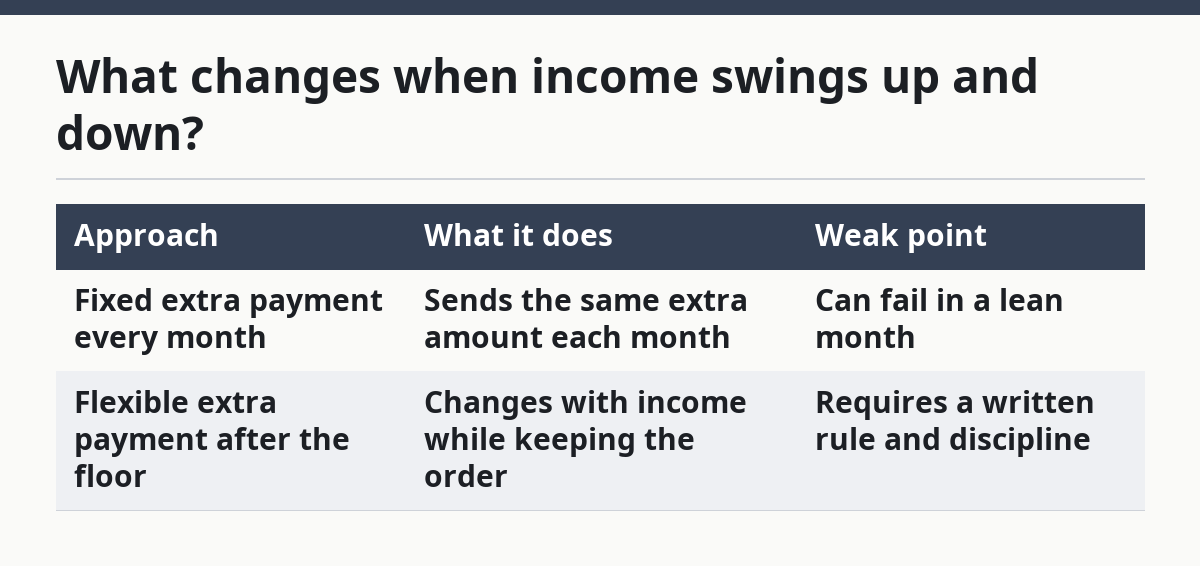
The flexible version is the better fit for irregular income because it respects cash flow gaps. The trade-off is that the payment amount will not feel as neat or predictable as a salary-based plan. That is the price of matching the plan to real income.
When should the snowball pause?
The snowball should pause when the base payment plan cannot cover minimums without borrowing again. That is the line where the method stops being a payoff system and starts becoming a scramble.

Minimum payments are at risk: This means the floor amount is too low for the current month — stop extra payments and cover every minimum first.
A paycheck is late or smaller than expected: This means cash flow has changed, not the debt order — hold the extra money until required bills are safe.
One debt is already past due: This means the snowball is not the first problem anymore — deal with the overdue account before sending extra to any other debt.
New debt was added to the list: This means the old order no longer matches reality — rebuild the list before continuing.
The plan depends on a future bonus or large tip: This means the payment is not real yet — do not count it as part of the current month.
In any of these cases, the right move is to slow down and reset the floor amount, not to force the order. The debt snowball is a sequencing tool, not a rescue plan for a month that cannot support the basics.
If the problem repeats for more than 1 cycle, or if overdue balances are piling up, a qualified adviser should review the full debt picture. The Consumer Financial Protection Bureau also has debt-management information that can help frame the next step: https://www.consumerfinance.gov/consumer-tools/debt-collection/ . The FTC also explains debt collection rights and warning signs here: https://consumer.ftc.gov/articles/debt-collection-faqs .
What mistakes break the order?
The most common mistake is using the average income month as the budget anchor. That can make the plan look stronger than it is, and then one weak month knocks out the minimum payments. The better choice is the floor amount that still works when income dips.

Another mistake is sending extra money to whichever debt feels most urgent that week. That turns the snowball into a guess-and-switch plan, which makes progress harder to track. The correct alternative is to keep one target debt until it is gone.
A third mistake is counting unpaid extra money as if it already exists. A bonus, a large tip, or a strong commission month is not part of the plan until the cash is in hand. If the money never arrives, the plan should not depend on it.
A fourth mistake is forgetting to roll the freed payment into the next debt. When a debt is paid off, its minimum payment should move forward with the snowball. If that payment gets absorbed into day-to-day spending, the payoff pace flattens.
A fifth mistake is failing to review due dates each month. With irregular income, timing matters as much as amount. If a bill comes due before the next paycheck, the plan may need a different holding pattern for that month.
What if the pattern still does not fit?
The standard snowball needs modification when the floor amount cannot protect the minimums, even in a careful month. In that case, the issue is not discipline; it is that the timing of income and bills does not match the current plan. A single order cannot fix a cash gap that is too large.
The other edge case is highly uneven income, where one month is strong and the next is very thin. For that setup, the payment rule has to be stricter: only money that is already in hand can count toward the current month’s extra payment. That keeps the plan honest and prevents overcommitting, and a qualified professional can help if the plan still feels too tight.
A final edge case is a debt with a very small balance but a very high minimum compared with the rest. The snowball still starts with the smallest balance, but the floor amount must include that larger minimum from day one. If it does not, the order is not the problem; the base amount is.
FAQ
How do I keep a snowball going with uneven paychecks?
Keep the debt order fixed and let the extra payment change with each paycheck. The monthly floor covers all minimum payments first, then anything above that goes to the current smallest debt. If income is low one month, the snowball can shrink without breaking.
Should I base the snowball on my lowest month or average month?
Base it on the lowest realistic month that still happens often enough to matter. An average month can look comfortable and still fail when a slow month arrives. The floor has to survive the lean month, or the plan is too fragile.
What if I can’t make the same extra payment every month?
That is normal with irregular income, and the extra payment does not have to be the same. Keep the same target debt and send whatever is left after minimums and essentials are covered. The order stays the same even when the amount changes.
Drafted with AI; not yet reviewed by a person.