Last updated: November 18, 2026
Key Takeaways
- Pick the first debt by urgency and consequences, not by annoyance.
- The lowest-interest route works best when every account is stable and current.
- Small balances help most when you need early wins to stay consistent.
- Avalanche saves more interest; snowball often helps you keep going.
Debt payoff prioritization — The Complete Guide is about choosing the order that gets you out of debt with the least damage to your cash flow and the most progress you can actually sustain. Quick Answer: use a rate-first order for about 80% of ordinary cases, then move tax, secured, or at-risk debts higher when their consequences are larger. This is not financial advice; for your own situation, especially if you have tax debt, secured debt, or risk of default, speak with a qualified financial adviser or debt counselor. The Consumer Financial Protection Bureau and the Federal Trade Commission both publish consumer debt guidance, and a qualified professional can help you apply it to your situation.
The real question: which debt should get the next dollar?

The right first debt is usually the one that creates the biggest problem if you ignore it, not the one that feels most annoying. For many people, that means looking at missed-payment consequences, interest rate, minimum payment size, and whether the debt is tied to a house, car, or legal deadline. A 20% APR credit card is painful, but a mortgage, auto loan, or tax debt can carry different consequences if you fall behind, depending on the contract and the agency involved.
A generic article often says, “pay the highest interest rate first” and stops there. That is too blunt. Interest rate matters, but it is only one part of the decision. A debt with a lower rate can still deserve priority if it has a short delinquency runway, a required minimum that strains your budget, or a collector who can escalate quickly. A debt with a higher rate can sometimes wait if it is small, current, and not threatening your essential assets.
The practical starting order is this:
- Keep current on anything that protects your housing, transportation to work, or tax standing.
- Make all required minimum payments to avoid late fees and credit damage.
- Put extra money toward the debt that is either the most expensive to carry or the most dangerous to miss.
- Revisit the order whenever a rate changes, a balance jumps, or a hardship hits.
The best prioritization plan is the one that keeps the account from spiraling while still moving principal down every month.
Should I pay off the highest-interest debt first?
Yes, if your goal is to minimize total interest and all your debts are already stable and current. This is the classic debt avalanche method, and it wins on pure math because every extra dollar goes to the balance costing you the most. If one card charges a much higher APR than the rest, attacking that balance first usually reduces the total cost of the debt stack over time.
The strength of this method is precision. It does not ask you to guess which balance feels worst; it asks which one is mathematically most expensive. That makes it especially useful when you have several credit cards, a personal loan, and maybe a store card, all with different rates and all current. It also avoids the trap of spreading extra payments across five balances, which usually slows momentum and leaves the most expensive debt untouched.
The weakness is psychological, and that weakness matters. If the highest-rate balance is also the largest balance, the win may feel slow for months. Some people quit before the first major balance disappears. That is not a math failure; it is a behavior problem. A plan that is optimal on paper but impossible to follow for six months is not actually optimal for that person.
This method is usually best for the person who can keep making the same decision every month without needing a visible quick win. It also fits anyone who is already disciplined about cash flow and does not need the emotional boost of wiping out a small account first. If you like clean rules and can ignore the temptation to “just throw a little at everything,” the avalanche method is hard to beat.
A useful caveat: the exact APR rules vary by country and by contract, and some debts have variable rates that can change. Check the current terms on each account before you lock in the order. The CFPB, the FTC, and your loan servicer’s statements are better references than guesswork.
When does the smallest balance deserve first place?
The smallest balance deserves first place when motivation is the limiting factor, not arithmetic. This is the debt snowball method: pay off the smallest balance first while making minimum payments on the rest, then roll that freed-up payment into the next smallest balance. It does not usually minimize total interest, but it can create the strongest sense of progress.
That psychological win is the whole point. If you have four debts and one of them is only a few hundred dollars while the others are much larger, eliminating that small account can make the whole plan feel real. For someone who has been stuck for years, that matters. A visible payoff can reduce avoidance and make the next payment easier to make on time.
The drawback is obvious and worth saying plainly: if you ignore a high-rate balance just because it is not the smallest, you may pay more interest overall. That is the trade-off. The snowball method is a behavior tool first and a cost-minimizing tool second. It is not wrong; it just optimizes for follow-through rather than for total finance cost.
This method fits a reader who has tried to budget before and failed because the plan felt too abstract. It also fits someone with several small consumer debts that are emotionally noisy, such as store cards or old medical balances. It is less compelling if the smallest balance has a very low rate and the largest balance is charging much more. In that case, the emotional win may cost too much.
A good rule: choose the snowball only if a fast first victory will keep you from abandoning the plan. If not, the avalanche usually makes more sense.
The honest side-by-side: avalanche vs. snowball
The avalanche wins on total interest; the snowball wins on motivation. That is the core trade-off, and everything else flows from it.
| Criteria | Highest-interest-first | Smallest-balance-first | Winner for [condition] |
|---|---|---|---|
| Total interest cost | Usually lower because the most expensive balance is attacked first | Usually higher because expensive balances may linger longer | Highest-interest-first when the main goal is reducing cost |
| Early visible progress | Can feel slow if the top-rate debt is large | Often strong because a small balance can disappear quickly | Smallest-balance-first when motivation is fragile |
| Rule simplicity | Simple if APRs are easy to compare | Simple if balances are easy to rank | Tie when the debt list is short, under 5 accounts |
| Best for variable-rate debt | Strong, because rising APR increases urgency | Weaker, because balance size may ignore rising cost | Highest-interest-first when rates can change |
| Behavioral fit | Best for disciplined planners | Best for people who need quick wins | Smallest-balance-first when follow-through is the issue |
| Risk of feeling stuck | Higher if the top debt is large and slow-moving | Lower because more accounts close early | Smallest-balance-first when morale is the main obstacle |
| Best use of extra cash | Directs extra payments to the most expensive balance | Directs extra payments to a fast win first | Highest-interest-first for cost control |
| Who should avoid it | People who need rapid reinforcement to stay engaged | People carrying one very high-rate balance that should not be delayed | Depends on whether psychology or cost is the bigger issue |
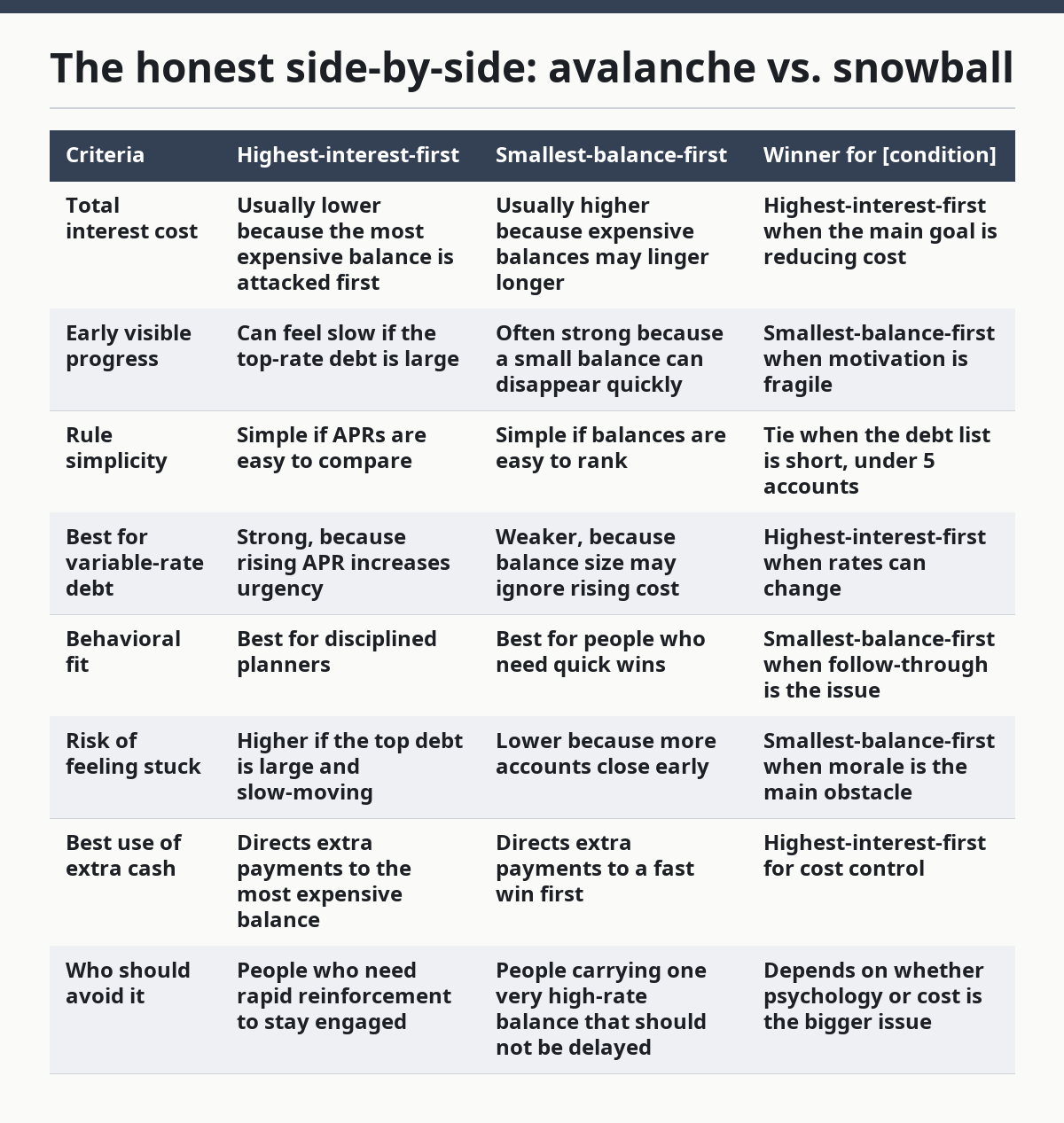
The table makes the choice clear: avalanche is the cleaner financial answer, but snowball can be the better execution answer. A generic article often acts as if those are the same thing. They are not. One minimizes cost; the other maximizes momentum.
There is also a hidden issue most articles miss: minimum payments can distort the order. If one account has a large minimum relative to its balance, it may deserve attention sooner because it consumes monthly breathing room. That is why the “best” priority list is usually not a single rule but a small ranking system. First keep every debt current, then pick the attack target based on rate, size, and the chance you will stay on plan.
What about credit cards, auto loans, and student loans?
Credit cards usually come first in priority when they carry the highest flexible rates and the most expensive compounding, but not always. A credit card with a high APR and a low balance is a strong avalanche target. A car loan, by contrast, can be more urgent if missing payments risks repossession and you need the vehicle for work. Student loan rules vary widely by country and by program, so the payment order should reflect the actual terms, not a generic stereotype.
Credit card debt is often the easiest place to target extra payments because the interest rate is typically far above that of an installment loan. The danger is that people keep using the card while paying it down. That turns a payoff plan into a revolving stall. If you are still adding new charges, prioritization alone will not solve the problem; you need a spending fix too.
Auto loans deserve a different lens. The interest rate may be lower than a credit card, but the asset is tangible, and missed payments can have immediate consequences. If keeping the car is essential for commuting, a current car payment may outrank a cheaper unsecured debt simply because the stakes are higher. This is one of the clearest places where “highest APR first” can be the wrong answer, so a qualified adviser can help if you are close to missing a payment.
Student loans are more complicated because repayment rules, income-based plans, grace periods, and forgiveness programs differ by country and program type. In some cases, the interest rate is not the only issue; the payment structure itself matters. Before reshuffling student loan priority, check the loan terms and any official repayment rules from the relevant government agency or loan servicer.
The practical takeaway: do not rank debt types by label alone. Rank them by what happens if you miss a payment, how fast the balance grows, and whether the debt is attached to something essential.
When the usual ranking is wrong
The standard ranking flips when the debt has special consequences that make it more urgent than its rate suggests. That is why a one-size-fits-all order is a mistake.
First, secured debt can outrank unsecured debt even if the rate is lower. If a mortgage or auto loan is attached to housing or transportation, the cost of falling behind can be immediate and severe. A credit card at a higher APR may be less urgent if the card issuer cannot take your car or your home. That does not make the card harmless; it just changes the order.
Second, tax debt can outrank almost everything else because tax authorities often have collection powers and deadlines that are different from a private lender’s. The exact consequences depend on your country and the tax agency involved. If you owe taxes, do not assume it belongs at the bottom of the list simply because no monthly statement looks alarming. Tax debt should usually be reviewed with professional help, especially if penalties are already building.
Third, debts in collections deserve closer attention if a lawsuit, wage garnishment, or judgment is a real possibility in your jurisdiction. The legal path varies by location, but the risk profile is very different from a normal credit card account that is merely expensive. A debt that can become a court issue should not be ranked the same way as a garden-variety installment loan.
Fourth, any account with a promotional or temporary rate deserves a fresh look when the promotional period is close to ending. A balance that looked manageable at 0% may become expensive fast once the promo expires. The exact date on the statement matters. Missing that timing can turn a low-priority balance into a high-priority one overnight.
The wrong move here is assuming all debt is interchangeable. It is not. The contract, the asset, and the legal path all change the order.
How to build your own payoff order without guessing
Start by listing every debt in four columns: balance, minimum payment, interest rate, and consequence of missing a payment. The consequence column matters more than most people think. A debt that is tied to your car, home, taxes, or a legal deadline may need higher priority even if the rate is not the highest on the page.
Then separate the debts into three buckets:
- Must stay current: housing, transportation, tax, and anything with a near-term legal or service cutoff.
- Costly to carry: high-rate unsecured balances, especially revolving credit.
- Low urgency but still owed: accounts that are current, low-rate, and not threatening essential assets.
Once the buckets are clear, decide which rule you are actually following. If total cost is the goal, rank by interest rate after the must-stay-current debts. If follow-through is the problem, rank by the smallest balance among the costly debts. If a debt has a deadline or legal exposure, move it upward even if it breaks the rule.
A simple worked example helps. Imagine five debts: a mortgage, a car loan, two credit cards, and a small medical bill. The mortgage and car loan are current. One credit card has the highest APR and a large balance. The other card has a lower APR but a tiny balance. The medical bill is small and in collections but not yet in court. In a pure cost-only plan, the high-APR card comes first after minimums. In a motivation-first plan, the tiny card might come first. If the medical bill has a real lawsuit risk, it may jump ahead of both.
That is the real job of prioritization: not picking a slogan, but building a sequence that matches your actual constraints.
For broad consumer debt repayment rules, a government consumer finance office or national debt advice service is usually a better source than a forum thread. For example, the U.S. Consumer Financial Protection Bureau has debt collection and budgeting guidance, and the Federal Trade Commission also publishes consumer debt material; in the UK, the MoneyHelper service is the official public starting point. The CFPB, FTC, and MoneyHelper all provide practical, current consumer guidance.
Which payoff order is right for you?
Choose highest-interest-first if you can stay disciplined, all your debts are current, and your main goal is lowering total interest. Choose smallest-balance-first if you need early wins to keep paying every month and the debt list is already causing avoidance. Neither if you are behind on housing, tax, or other essential payments, because those debts need a separate review before any payoff order makes sense.
That is the clean answer. It is not a moral judgment, and it is not a universal rule. It is a match between method and problem. A person with stable income and five credit cards can usually use the rate-first approach. A person who freezes when they do not see progress may need the snowball just to keep going. A person with tax debt, a threatened car repossession, or a mortgage arrears notice should not treat this as a simple ranking exercise at all.
One more useful test: if your chosen order makes you likely to miss a required payment somewhere else, it is the wrong order. A payoff plan that creates new delinquencies is not a payoff plan. It is a reshuffle of risk.
Exception scenarios that flip the verdict
The verdict changes when the debt stack has a special feature that the standard methods ignore. Those cases are rare enough to name, and common enough to matter.
First, if one debt is a legal or tax problem, it can jump the line even if the rate is lower. Tax debt, judgments, and some collection accounts deserve separate attention because the consequences can escalate in ways a normal credit card does not. The legal details differ by country, so this is the point to consult a qualified adviser.
Second, if a secured loan protects housing or transportation, a current payment may outrank a higher-rate unsecured debt. Losing the car you need for work or falling behind on housing can cause more damage than paying extra interest for a while. That does not mean secured debt is always the top priority; it means the consequence matters as much as the rate.
Third, if a temporary low rate is about to expire, the balance can move up the list fast. Promotional APRs change the math at the date the offer ends. If you know that date from the statement, prioritize the balance before the rate resets if it would become expensive.
Fourth, if your emergency fund is zero and one unexpected bill would force you to re-borrow, a tiny buffer may need attention before extra debt payments. That is not a debt-priority rule in the pure sense, but it can be the difference between steady progress and backsliding. A financial adviser can help decide whether a small cash reserve should come before more aggressive payoff moves.
The final call
The right debt payoff order is the one that protects essentials first, then attacks the debt that is either most expensive or most likely to derail your plan. Interest rate is the best default rule, but it is not the only rule that matters.
If you want the shortest path in interest cost and you can stick with the plan, start with the highest-rate debt after minimum payments. If you need motivation to keep going, start with the smallest balance after minimum payments. If a debt can threaten housing, transportation, taxes, or legal standing, move it up the list and get professional guidance before you assume a normal payoff method will handle it.
Drafted with AI; not yet reviewed by a person.