Last updated: August 10, 2026
- Don’t build your whole plan around tax refunds, bonuses, or side income that may never show up.
- Once that debt is gone, roll its full payment into the next one.
- But it works because the order is easy to repeat month after month.
- Your situation may point you toward a qualified financial adviser or another professional.
Quick Answer: List debts from smallest to largest balance, keep paying minimums on everything, and throw every extra dollar at the tiniest balance. Once that debt is gone, roll its full payment into the next one. Simple. But it works because the order is easy to repeat month after month.
The debt snowball method is for people who need momentum more than they need mathematical perfection, and this guide shows how to use the debt snowball method to stay motivated without losing steam. When you keep stalling, guessing, or drifting off your debt plan, the method gives you one clear target: pay the smallest balance first, then move that payment to the next debt. I’ll show you how to use it in a way that keeps you moving, and I need to be blunt here: this is general information, not financial advice. Your situation may point you toward a qualified financial adviser or another professional.
Key facts
– Pay minimums on all debts, then send every extra dollar to the smallest balance.
– The snowball is a behavioral method, not the lowest-interest method.
– When you need visible progress, one paid-off debt can create momentum fast.
– Should your budget be unstable, fix cash flow before you add a larger payment.
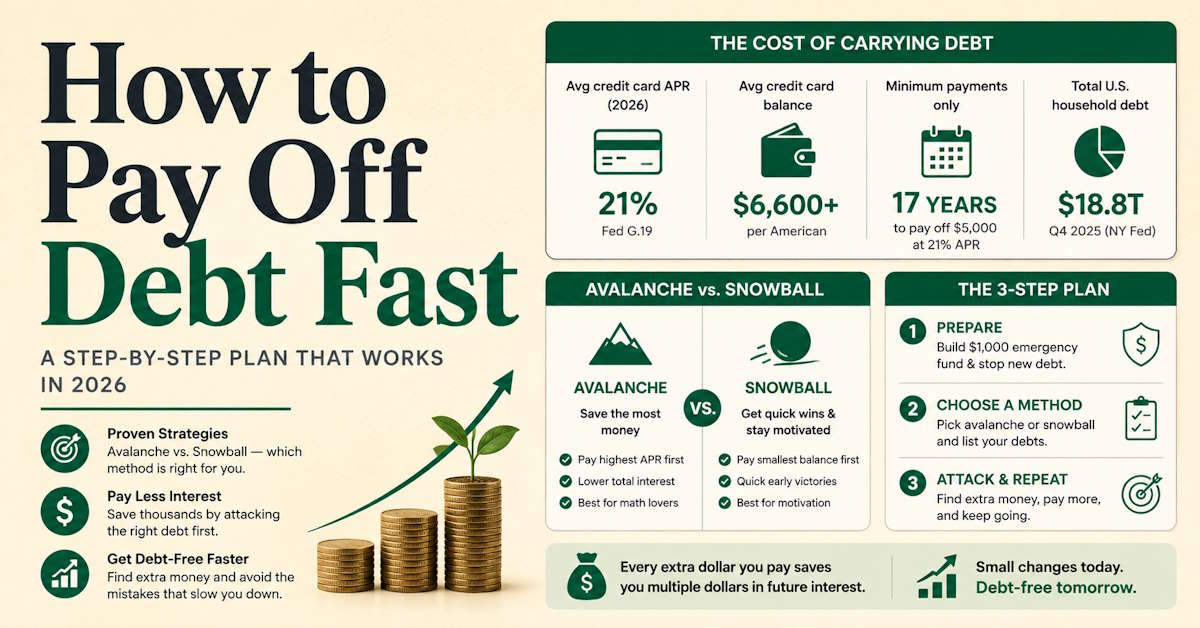
– Debt snowball vs avalanche: snowball helps motivation; avalanche usually saves more interest.
Start Here If You Need Momentum, Not Perfection
A payoff plan that collapses after three good weeks? That is exactly where the debt snowball fits. Should consistency be your main problem, this method is built for that. It is not always the cheapest path on paper. Trade-off. Plain and simple.
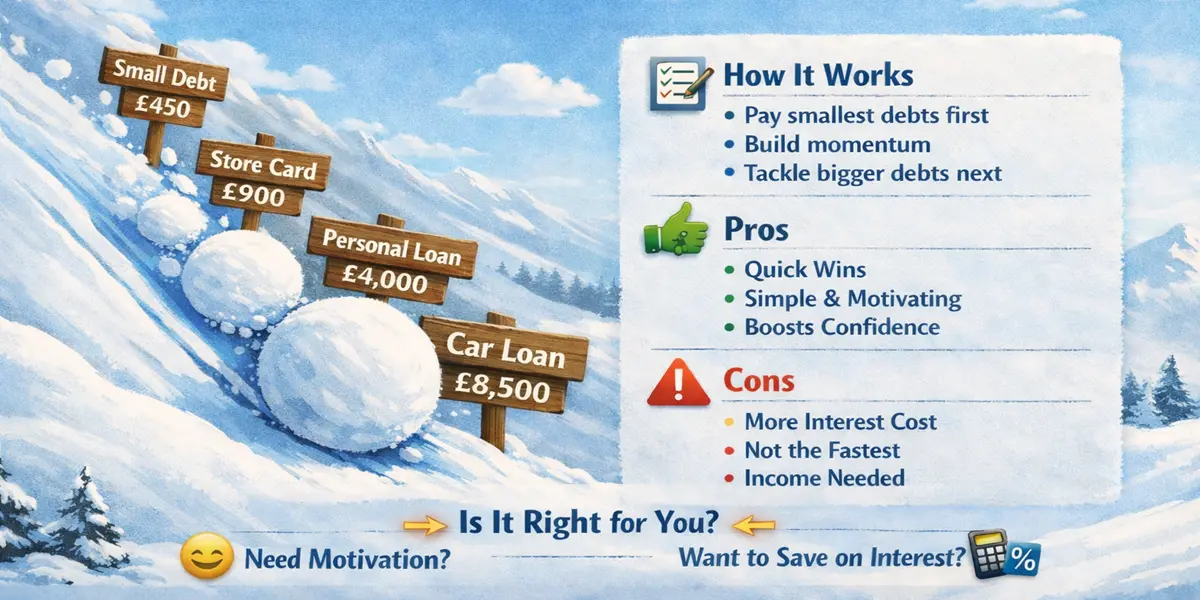
Here’s the core move: line up every debt from smallest balance to largest, make minimum payments on all of them, and aim every extra dollar at the smallest one. When that debt disappears, take the payment you were sending there and add it to the next debt. The payment “snowballs.”
Small wins matter here. When you get discouraged by giant balances that barely budge, snowballing is often easier to stick with than a pure interest-first plan. But should you be highly disciplined and your highest-interest debt is huge, another payoff order may save more interest over time.
Use this approach if:
– You need visible progress to stay engaged.
– You have several debts and keep losing steam.
– You do better with simple rules than with optimization.
Do not use it blindly if:
– You are behind on rent, utilities, or other essentials.
– A debt has a collection, legal, or default issue that needs immediate attention.
– Your budget has no room for even minimum payments without creating new debt.
- Write down every debt, the balance, the minimum payment, the interest rate, and the due date.
- Order the debts from smallest balance to largest balance.
- Make sure minimum payments are covered first.
- Find one extra amount you can repeat every month, even if it is small.
- Send the extra amount to the smallest debt only.
- When that debt is gone, move its full payment to the next debt.
Quick check: need fast wins to keep going? This is probably the right method to try. Should your budget already be cracking, fix the budget first.
Build a Snowball That You Can Actually Keep Rolling

A plan built on “finding extra money someday” usually dies on the vine. Real momentum needs real cash, not wishful thinking. So you have to choose a payment you can repeat without betting on willpower.
I’d split your debts into two groups: the ones that need protection right now and the ones you’re actively attacking. Essentials first. Minimums next. Only then do you set the snowball amount.
When your income is steady, pick one fixed extra payment and automate it. Should your paychecks jump around, use a smaller base snowball and add windfalls only when they appear. Don’t build your whole plan around tax refunds, bonuses, or side income that may never show up. Helpful? Yes. The backbone? No.
A rule I like: choose a number that stings a little but doesn’t blow up the month. When the payment is so aggressive that you start charging groceries, the plan is too tight. That math stops working fast.
Use this workflow
- List your bare-minimum monthly expenses first: housing, food, utilities, transportation, insurance, and required debt minimums.
- Subtract those from your take-home pay.
- Set aside a small buffer for irregular basics if your bills vary.
- Choose an extra payment you can make every month without borrowing again.
- Automate the minimums and the extra payment if your lender allows it.
- Review the number after one or two cycles and adjust only if the budget is stable.
When you feel tempted to launch a huge snowball, ask whether you’re paying with discipline or with hope. Hope is not a payment plan. Not even close.
Quick check: can you name the exact extra amount and explain where it comes from? Good. Should not, it’s still a wish.
Use Small Wins to Stay Motivated When Progress Feels Invisible
Progress can feel invisible when a balance barely moves, and that is where motivation gets slippery. The debt snowball helps because it creates proof. A tiny debt vanishing feels real. People underestimate that.
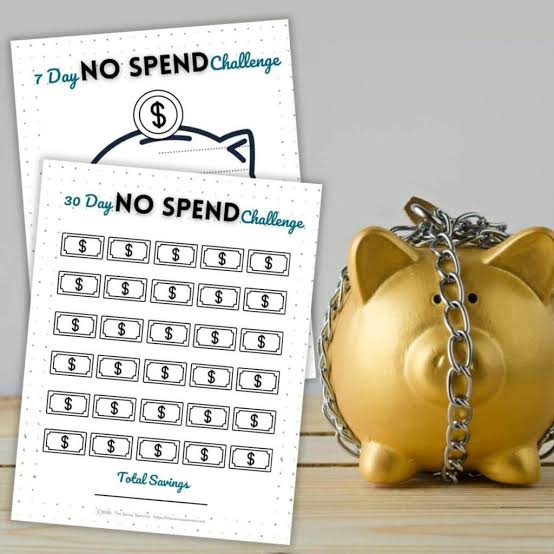
Don’t rely on memory. Put the wins where you can see them. A payoff tracker, a spreadsheet, a whiteboard, or a notes app all work if you actually check them. The point is to make progress visible before your brain starts whispering that nothing is changing.
When you’re paying down debt with a partner or family member, make the wins public in the smallest healthy way. A shared chart, a monthly check-in, or a simple “one debt gone” note can keep both people engaged. Should debt be a private stressor for you, keep it private from everyone except the people who need to know. Motivation should not turn into a performance.
A practical motivation system
- Choose one place to track every debt payoff date and remaining balance.
- Mark each minimum payment as complete the day it clears.
- Highlight the smallest debt in a different color so the target stays obvious.
- Celebrate a payoff with a free or low-cost reward that does not add new debt.
- After each payoff, update the next target immediately.
- Keep a short note about why you started: less stress, fewer calls, more room in your budget, or a cleaner credit profile over time.
Honestly, this is the part people skip. The catch is that motivation tools do not fix an unaffordable debt load. Should the numbers truly not fit, you may need to talk with a nonprofit credit counselor, your creditors, or a qualified adviser about other options. The Consumer Financial Protection Bureau and the National Foundation for Credit Counseling both recommend getting help early when debt becomes unmanageable.
Quick check: when you can see progress clearly, you are more likely to stick with the snowball. Should not, make the progress visible before you judge the method.
When Snowball Is Better Than the Interest-First Approach

Torn between the smallest balance first and the highest-interest debt first? The real question is not which one looks neater on a spreadsheet. It’s which one you’ll actually follow long enough to finish.
The debt avalanche method, which targets the highest interest rate first, usually has the better math outcome. But the snowball often wins on behavior. When you have a history of abandoning detailed plans, the method you finish beats the method you admire.
Still, snowball is not the right answer for everyone. Should one debt have a very high interest rate and the balances be similar, ignoring that rate can cost real money. Should you be highly organized, disciplined, and unlikely to quit, you may prefer the interest-first path. I wouldn’t claim there’s one universal winner.
Here is a simple comparison.
| Situation | Best Path | Why Other Options Fail |
|---|---|---|
| You need quick emotional wins | Debt snowball | Interest-first can feel slow and easy to quit. |
| You stay motivated with spreadsheets and optimization | Debt avalanche | Snowball may keep you engaged, but it may not be the most efficient. |
| Your balances are close, but rates vary a lot | Compare both methods before deciding | Picking by balance alone may ignore the real cost difference. |
| You have had several failed payoff attempts | Debt snowball | Complex plans often fail again for the same reason. |
The trade-off is simple: snowball may cost more in interest than avalanche. Should that difference matter a lot in your case, ask a qualified financial professional to help you compare the options using your actual balances and rates. See how to choose between debt payoff methods and how to build a monthly budget for related planning steps.
Quick check: if consistency is your weak point, snowball may be the safer behavioral choice. Should optimization be your strength, compare it with avalanche.
Edge Cases That Change the Answer
Messy situation? Then the standard snowball advice may be the wrong tool — or only part of it.
-
Situation: You are missing minimum payments.
What changes: Motivation matters less than damage control.
Use this instead: Cover essentials first, contact creditors if you can, and look at hardship options, a nonprofit credit counselor, or other assistance before adding a snowball payment. -
Situation: One debt is in collections or legal trouble.
What changes: The smallest balance is not always the most urgent debt.
Use this instead: Address the account with the legal or collection risk first, because delay can create extra costs or bigger consequences. -
Situation: Your income changes month to month.
What changes: A fixed extra payment may be unrealistic.
Use this instead: Set a small base snowball you can make in lean months, then use variable income only as a bonus. Do not count on windfalls to carry the plan. -
Situation: You are carrying high-interest revolving debt and can’t stop using the card.
What changes: Paying the smallest balance first may not stop the debt cycle.
Use this instead: Fix spending leaks and payment timing first. If needed, cut off the source of new borrowing before focusing on payoff order. -
Situation: Your debts include student loans, tax debt, or secured loans.
What changes: Those debts can have special rules, repayment options, or consequences.
Use this instead: Read the account terms carefully and get advice from a qualified professional before assuming a standard snowball order fits. See StudentAid.gov loan repayment options and IRS payment plans for official guidance. -
Situation: You and a partner share debt but not the same goals.
What changes: A purely mathematical plan can turn into an argument.
Use this instead: Agree on one debt list, one payment order, and one monthly check-in before trying to optimize the sequence.
Quick check: if any debt has legal risk, special rules, or unstable cash flow, pause the standard snowball and handle the exception first.
How to Keep Going After the First Debt Is Gone
If the first win is the only thing that lights you up, the real test is the second debt. That’s where people get sloppy: they celebrate, ease up, and lose the payment momentum that made the method work.
Because that momentum can vanish quickly, treat each payoff as a process change, not just a victory. The amount you were paying on the first debt should not disappear into your spending. It should move right away to the next target. When you want a visual reminder, write the new payment amount down the same day the old debt hits zero.
I’d also keep your rewards small and predictable. A reward should mark progress, not erase it. A meal out, a day trip, or a free activity can be enough if it doesn’t reopen the hole you just filled.
A repeatable payoff cycle
- Confirm the smallest debt is fully closed and no extra payment is still queued there.
- Redirect that exact payment amount to the next debt in line.
- Update your tracker so the next balance is the new focus.
- Check whether any due dates changed and adjust the payment timing if needed.
- Keep minimum payments on the remaining debts on autopilot where possible.
- Repeat the same cycle every time a balance disappears.
The biggest mistake is treating that freed-up payment like “extra money.” It isn’t extra. It is the engine. Lose that, and the snowball stalls.
Quick check: when you already know where the freed payment goes next, you are using the method correctly. Should not, the snowball is leaking.
The Mistakes That Break Motivation Fast
When the snowball stops working, the method is usually not the problem. One of a few common mistakes is.
First, people make the snowball too ambitious. They assume motivation will rise to meet the payment. Usually it does the opposite. Start smaller if needed.
Second, they keep too many decisions manual. If you have to remember every due date and every transfer, friction will beat you. Automation helps where your lenders and bank allow it.
Third, they confuse progress with permission. A paid-off debt can make you feel richer than you are. If that feeling turns into new borrowing, the snowball collapses.
Fourth, they ignore the emotional side. Debt can make people ashamed, angry, or avoidant. Should opening the app make you want to disappear, the plan needs more structure, not more self-criticism.
Here is the simplest way I know to protect the method:
– Keep one visible debt list.
– Use one regular payment schedule.
– Update the next target immediately after each payoff.
– Do not add new consumer debt while you are trying to snowball out of old debt, unless a genuine emergency and your own judgment say otherwise.
– Reassess if the plan is making your whole budget unstable.
The debt snowball is useful because it is easy to follow when life is noisy. It is not magic. It works when you pair it with a budget, a visible tracker, and a payment you can repeat.