Last updated: November 20, 2026
Quick answer: get 1 written confirmation — an email, letter, or secure message — before you make the next payment. A phone promise can help start the process, but the written confirmation email or letter is what you should keep, check, and follow. This page explains how to confirm a debt payment arrangement in writing before you rely on it, because a temporary promise only becomes safer when the terms are documented. If you are unsure how the wording affects your account, a consumer lawyer or HUD-approved housing counselor can help you review it. For general debt-payment communication, see the Consumer Financial Protection Bureau and the Federal Trade Commission.
Who this applies to
This applies if you have already spoken with a creditor or servicer about a temporary payment arrangement and now need proof before you act on it. It assumes you know the account name, the basic payment amount you discussed, and the date of the call or message. It also assumes the arrangement is temporary, not a full payoff plan.
Because this is the point where a conversation turns into a record, this page starts after the call and before the first changed payment. It is not the right page if you still need help asking for a change, writing a hardship letter, or figuring out how to document the call itself; those are separate steps. For related help, see how to negotiate with creditors and what to include in a hardship letter, then come back to the written confirmation step.
A payment arrangement confirmation is only useful if it names the account, the terms, and the date it becomes active. If any of those pieces are missing, the confirmation is too thin to rely on. The CFPB’s debt collection resource page and the FTC’s debt collection FAQs are the best public sources for general guidance, and you can compare any written terms against your own call notes.
Key takeaways
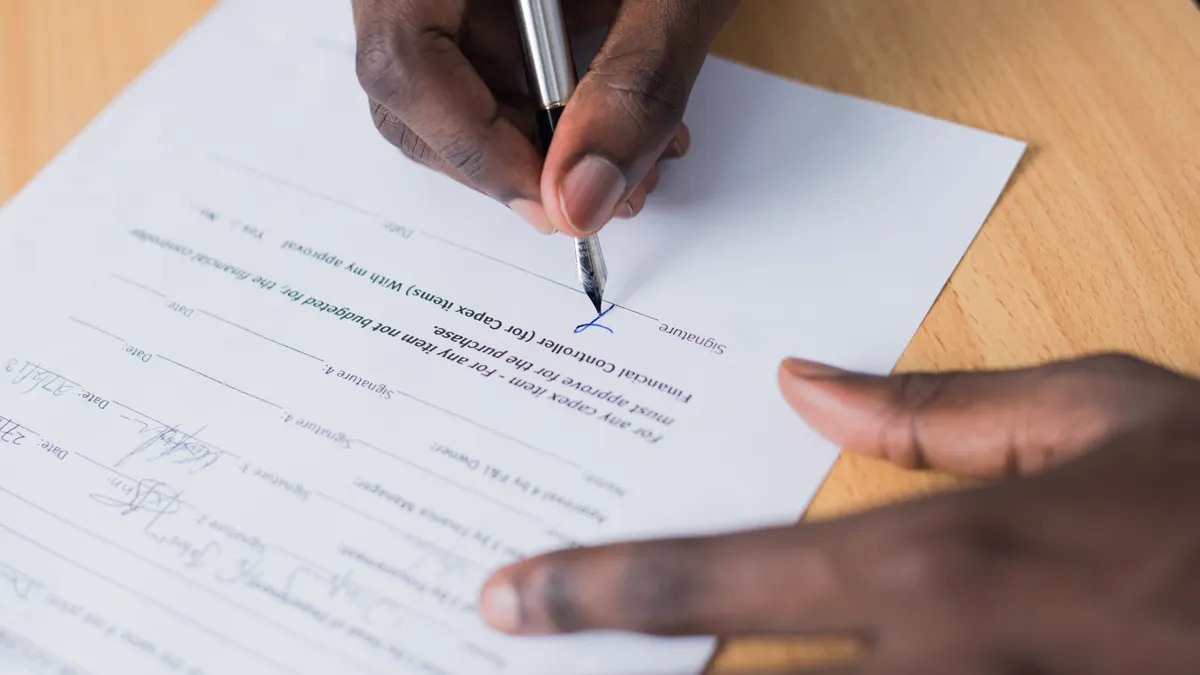
- Treat a verbal promise as temporary until the creditor or servicer sends written proof, and if the wording is unclear, ask a consumer professional to review it.
- Check the account number, payment date, amount, and any skipped-payment terms.
- Save the confirmation in more than one place, including email and a downloaded file.
- If the writing and the phone call disagree, the mismatch matters more than the promise.
- Missing details can turn a “deal” into a misunderstanding that still shows up as a missed payment.
How do you confirm it in writing?
You confirm it in writing by getting the creditor or servicer to restate the agreement in a message you can save, then checking that the terms match what you understood. A confirmation email is often easiest to keep, but a letter or secure message can also work if it shows the same terms and can be saved safely; if you are unsure which format best protects your account, ask the creditor, servicer, or a consumer attorney.
Use the written record to verify facts, not feelings. If the message is vague, incomplete, or only says “we discussed your account,” it is not enough. If the account is with a servicer rather than the original creditor, the same rule applies: the entity handling the account needs to confirm the arrangement. For more on account records, see debt collection rights and .
How do I get the terms on paper?

You get the terms on paper by asking for a written confirmation in the same channel the creditor or servicer uses for account communication. If they use email, ask for an email. If they use a secure portal message, ask them to place the terms there, and if you are unsure whether that is enough, ask a consumer lawyer or the servicer what written format they treat as official. If they only send letters, ask for a mailed copy as well.
What should the confirmation include?
The confirmation should include the account identifier, the payment amount, the due date, the start date, the end date if there is one, and what happens to any skipped or reduced payments. It should also say whether fees, interest, or late marks continue during the arrangement.
If the message does not name the exact arrangement, it is too weak to trust. A line that says “payment plan approved” does not tell you whether the next payment is reduced, deferred, or due on a different date. Clear confirmations usually read like short instructions, not a vague reassurance.
How to confirm a debt payment arrangement in writing, step by step
-
Open your email and send a same-day follow-up message.
Write to the creditor or servicer within 24 hours of the call if possible. Include the account number, the date and time of the call, and the arrangement you understood in one short paragraph. Verify that the message includes the same monthly amount or temporary payment amount you discussed; if it does not, the reply may not match your understanding. If you need a model for this, compare it with debt payoff communication tips. -
Ask for a confirmation email or letter.
Request a written confirmation that repeats the exact terms of the payment arrangement. Ask for the form you can save, such as a confirmation email, mailed letter, or secure message, and if you are unsure whether the format is sufficient, ask a qualified consumer adviser before you rely on it. If they refuse to put it in writing, that is a warning sign because you cannot easily prove the terms later. -
Check the account notes with the agent’s name and date.
Ask the representative to note the account with the arrangement terms and the date of the agreement. Then verify that the note includes the payment amount, the due date, and the length of the arrangement. If the agent cannot confirm the note on the call, the arrangement may not be entered correctly. -
Compare the written terms against your call notes.
Lay the email or letter beside your own notes from the call and compare each line. Look for the same dollar amount, due date, start date, and any skipped-payment language. A mismatch on one term is enough to stop and ask for a correction before you pay anything. -
Save the message in two places.
Download the confirmation and save it in a folder on your device and in your email account. Keep the file name simple, such as the creditor name and the month. If the message disappears from the inbox later, a second copy protects you from losing the record. -
Confirm the next payment date before you send money.
Check whether the first payment under the arrangement is due immediately, on the next regular due date, or on a new date. Verify the schedule before you rely on it because sending the wrong amount on the wrong day can break the arrangement. If the date is missing, the arrangement is not complete. -
Check whether the arrangement affects automatic payments.
Ask whether autopay should stay on, be paused, or be changed. Verify the answer in writing because an automatic draft can pull the old amount even after a temporary change is approved. If the written confirmation says nothing about autopay, assume nothing. -
Keep one follow-up contact ready if the wording is unclear.
Reply right away if the confirmation leaves out a term or uses a phrase you cannot interpret. Ask for the missing detail in plain language, such as “Please confirm the first payment date and whether fees will continue.” If they will not clarify in writing, do not rely on the arrangement yet.
What should I check before I pay?
You should check the payment amount, the due date, the account number, and whether the arrangement changes fees or interest. Those four items are the minimum. If one of them is wrong, a payment sent in good faith can still leave the account delinquent.
Also check whether the arrangement is temporary or permanent. A temporary arrangement usually ends on a stated date or after a set number of payments. If the confirmation does not say when the arrangement ends, ask before you assume it continues.
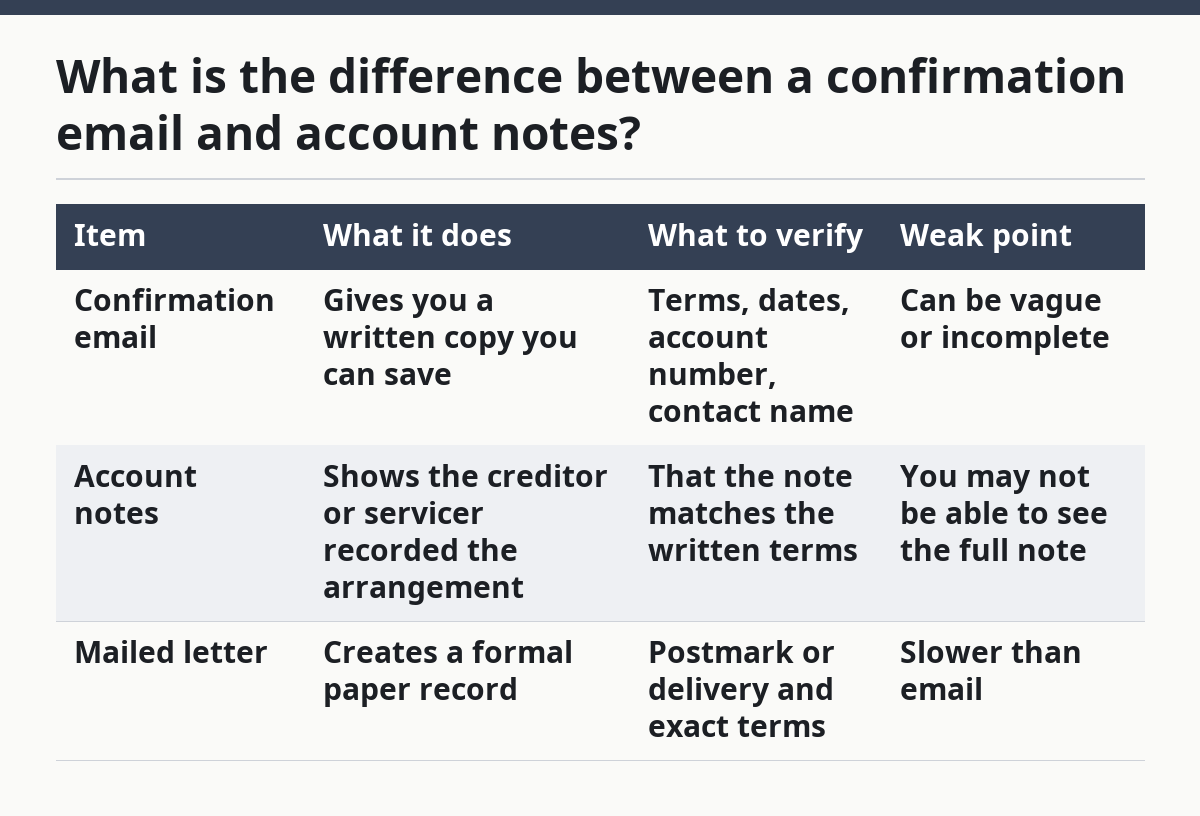
What is the difference between a confirmation email and account notes?
A confirmation email is the message you can keep and read later, while account notes are the internal record the creditor or servicer says it put on the file. Both matter, but the email is easier for you to prove and save. Account notes are useful because they show the arrangement was entered, not just discussed.
| Item | What it does | What to verify | Weak point |
|---|---|---|---|
| Confirmation email | Gives you a written copy you can save | Terms, dates, account number, contact name | Can be vague or incomplete |
| Account notes | Shows the creditor or servicer recorded the arrangement | That the note matches the written terms | You may not be able to see the full note |
| Mailed letter | Creates a formal paper record | Postmark or delivery and exact terms | Slower than email |
When should you stop relying on the arrangement?
You should stop relying on the arrangement and ask for more proof when any of these situations appears.
The account number is missing: This means the message may not be tied to the right debt — ask for a corrected confirmation before paying.
The due date is different from what you discussed: This means the arrangement may have been entered wrong — hold off until the creditor or servicer fixes it in writing.
The confirmation mentions “may,” “could,” or “subject to review”: This means the terms may not be final, so do not treat it as fully approved without checking with the creditor, servicer, or a consumer professional.
The email does not say what happens to fees or interest: This means a later balance may be higher than you expected — request that point in writing.
The agent refuses to name the arrangement in a message: This means you lack proof if the account is reported late later — escalate the request through the creditor’s or servicer’s official contact method.
The payment portal still shows the old amount only: This means the system may not have been updated — verify the change before the next due date.
What mistakes do people make most often?
The most common mistake is treating a phone call as enough. That can cost you proof if the account later shows a missed payment or a different balance. The correct alternative is to get the confirmation email or letter before you depend on the arrangement.
A second mistake is reading only the first sentence of the message. Some confirmations sound positive at the top but bury the real terms in the middle, where the due date or fee rule is different. The better habit is to check every line for amount, date, and duration.
Another mistake is assuming the arrangement covers automatic drafts. A creditor or servicer can approve a temporary change and still pull the old payment if autopay stays active. The safer step is to confirm the autopay status in writing.
A fourth mistake is ignoring account notes because they are internal. If the note and the email disagree, the mismatch needs attention right away. The written record is only useful if the external message and the file note line up.
A fifth mistake is waiting until the next due date to ask questions. By then, a missing detail can turn into a late or partial payment problem. The right time to correct the record is the same day you receive the confirmation.
When does the standard approach need to change?
The standard approach needs to change if the creditor or servicer uses a secure portal instead of email, if the account is handled by a third-party collector, or if the arrangement is only partly approved. In those cases, the proof may come in a portal message, a mailed letter, or a logged note rather than a normal email thread.
If the arrangement involves more than one debt, confirm each account separately. One written confirmation does not automatically cover two accounts, even if the same person handled both calls. Ask for one record per account so nothing gets crossed.
If the creditor or servicer says it will send a letter later, ask what you should do until the letter arrives. A delay of even a few business days can matter if the due date is close. Do not assume the arrangement protects you until the writing matches the call.
Where this fits in the bigger debt plan
This step sits inside a larger debt payoff communication process, but it is not the same as negotiating the arrangement or rebuilding after missed payments. It is the checkpoint that keeps a temporary promise from turning into a false one. If the arrangement is only a short bridge, the written confirmation is the proof that the bridge exists.
For readers working through debt payoff communication and hardship, this page belongs after the call and before the first changed payment. That order matters because a debt account reacts to records, not intentions. A clear written record is what lets you act with less guesswork. For the next steps, see and what to do after a missed payment.
Should I get a hardship agreement in writing?
Yes, you should get a hardship agreement in writing before you rely on it. A verbal approval can be misunderstood, and a written record gives you the exact terms to check later. If the creditor or servicer will not put it in writing, treat the arrangement as unconfirmed.
What details should be included in a payment arrangement?
The payment arrangement should include the account number, payment amount, due date, start date, end date, and any change to fees or interest. It should also say what happens to skipped or reduced payments. If any of those details are missing, ask for a corrected confirmation before you send money.
How do I know if a verbal agreement is real?
A verbal agreement is only real enough to trust when it is repeated in writing and matches your notes. If the email or letter confirms the same terms, that is a strong sign the arrangement was entered correctly. If the writing is vague or different, the verbal promise is not enough on its own.
Drafted with AI; not yet reviewed by a person.