Last updated: August 10, 2026
A $500 card feels different from a $15,000 one. So does a 24% APR. That gap matters.
Quick Answer: pay off small debts fast: simple order tackle balances by sending extra money to the smallest balance first when motivation is your main issue, or to the highest-interest debt first when cost is your main issue. In many real cases, the difference is not huge on one balance, but across several debts it can add up. Pick the wrong order, and you can stall out. I want the cleanest way to choose without turning this into a spreadsheet project.
Key Facts / Key Takeaways
– Pay off small debts fast: simple order tackle balances is a behavior-first strategy when you need quick wins.
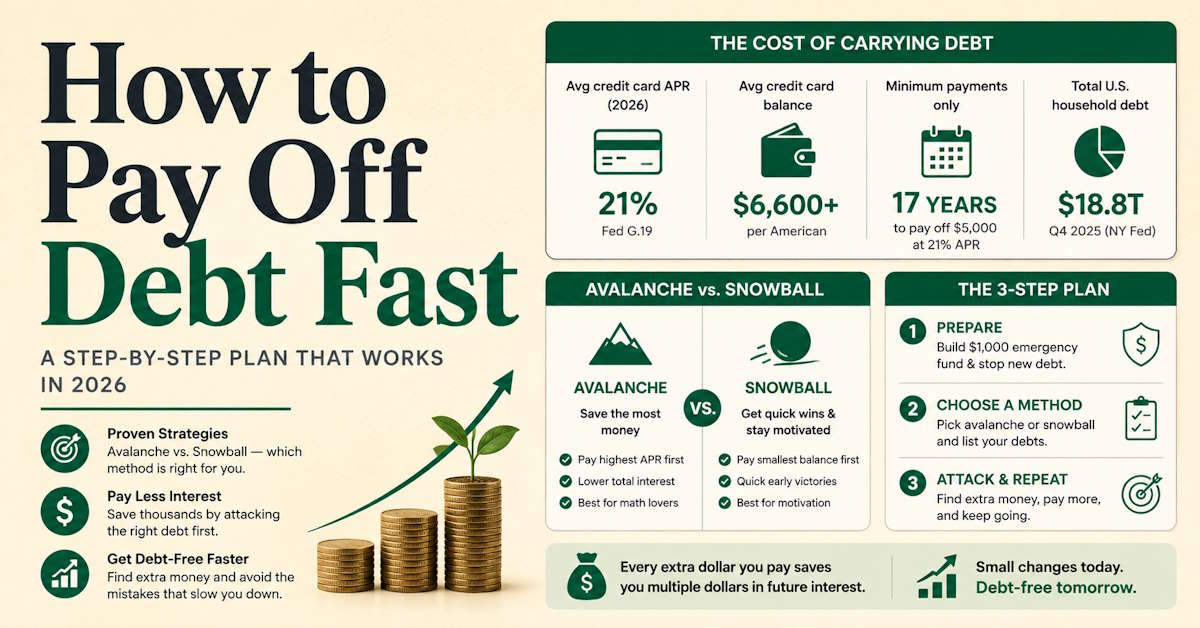
– The snowball method targets the smallest balance first; the avalanche method targets the highest interest rate first.
– If rates are similar, the emotional benefit of clearing an account can outweigh a modest cost difference.
– When one debt has a much higher rate, highest-interest-first usually reduces interest more if you stay consistent.
– Should you be missing minimum payments, the order matters less than stabilizing essentials and getting help.
– For tax debt, student debt, or secured debt, check the rules with a qualified adviser before you change your payoff order.
– Consumer debt average interest rates can be high: for example, the Federal Reserve’s G.19 data reports credit card rates well above many other forms of borrowing.
I write about personal finance, and I’m careful with debt advice because the stakes are real. This is information, not financial advice; your own situation may call for a qualified adviser, especially if you’re juggling missed payments, variable rates, or tax issues that differ by country. For broader context on repayment prioritization, see the Consumer Financial Protection Bureau and the Federal Reserve.
The Real Difference Between the Snowball Method and the Avalanche Method
Simple split: snowball gives you a quick win. Avalanche cuts interest cost. I’d use snowball when momentum matters more than math, and avalanche when you can stick with a plan long enough for the savings to show up.
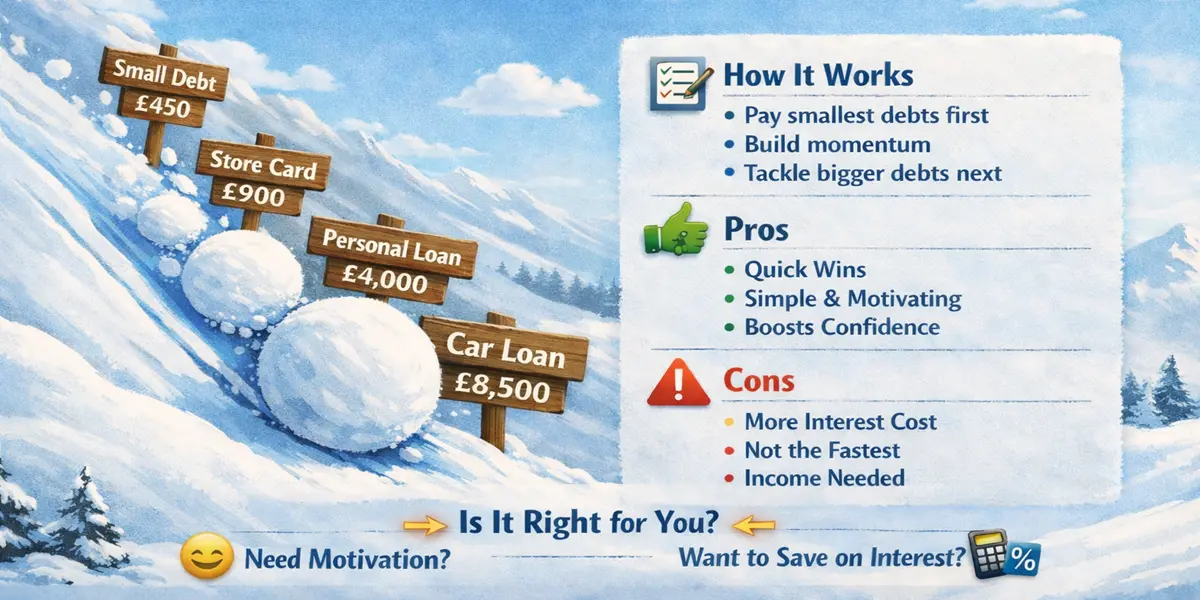
With snowball, you line up debts from smallest balance to largest balance. Minimum payments go on everything; every extra dollar then hits the smallest balance until it disappears. After that, the freed-up payment rolls into the next smallest debt. The payoff feels immediate. Nice, even. One closed account can make the whole thing feel possible.
The trade-off? You may pay more interest overall than you would with another order, because a small balance is not always the expensive balance.
Avalanche works the other way. Highest interest rate first, lowest last. Same minimum-payment rule, same extra-payment rule, different target. On paper, this is the more efficient method because the priciest debt stops growing first. The downside is psychological, not mathematical: if your top-rate balance is also a big one, progress can feel glacial.
Most people asking this question are not hunting for finance theory. They want something they can actually follow on a normal paycheck. So the real question is not “which is better in general?” It is “which order will I keep using until I finish?”
Small Debts First: Who Should Actually Use This (and Who Shouldn’t)
Small debts first works best for people who need visible progress to stay engaged. I’d choose it if you get discouraged when a plan looks endless, or if several annoying balances are piling up and you need one account gone quickly to feel back in control.
Behavior is the strength here. A closed debt changes the shape of your month. One fewer payment means one less bill to track, one less due date to miss, and one less account nagging at you. When you are rebuilding after a rough stretch, that matters.
It also fits better when the balances have roughly similar interest rates. In that case, the emotional boost can outweigh the modest cost difference. Plenty of generic advice skips that and talks as if every debt carries wildly different pricing. They don’t. Say one balance is 14.9% and another is 16.1%; the gap may matter less than the morale boost of wiping out the smaller account first.
But small does not mean cheap. A tiny balance at a high rate can be a worse target than a larger, lower-rate debt. Follow the smallest-balance rule blindly, and you can spend longer carrying expensive debt than you need to. That has a real cost. The Consumer Financial Protection Bureau recommends choosing a payoff method you can actually sustain.
I would not make small-debts-first my default when one balance has a clearly higher rate than the rest and you already have decent follow-through. I also would skip it if the bigger problem is cash-flow stress, repeated overdrafts, or collection risk; then the order matters less than getting a workable budget and protecting essentials.
Highest-Interest First: The Specific Situations Where It Wins
Highest-interest first wins when your main goal is to reduce total borrowing cost and you can tolerate slower early progress. I’d choose it when the rate gap between debts is meaningful, because that is where the math starts to matter.
This method suits disciplined payers who do not need constant encouragement. If you can keep sending extra money to the same target month after month, avalanche is the cleaner system. It removes the costliest debt first, which can shorten the time you spend paying interest on top of interest. On a $3,000 balance at 24% APR, even a few months of extra interest can add up.
It also fits people with a stable routine: steady income, reliable minimum payments, and enough cushion that a slower visible payoff will not throw them off. If you do not need emotional wins to stay on track, why pay extra interest just to see an account disappear sooner? The Federal Reserve’s consumer credit data shows why this can matter: revolving credit, especially credit cards, often carries rates that are materially higher than many other debts.
The weak spot is obvious. It can feel unrewarding at the start. If your highest-rate balance is large, it may look like nothing is happening for a while. That is not a flaw in the method; it is the method doing exactly what it is built to do. But if that feeling makes you quit, the “best” plan becomes the wrong plan.
I’d skip avalanche if you know you are likely to abandon the process before the first big balance moves. A method that saves money only matters if you keep using it. For rate data and broader borrowing context, the Federal Reserve’s G.19 Consumer Credit release is a useful reference.
The Honest Side-by-Side
Plainly: snowball is about behavior. Avalanche is about cost. The right choice is the one that fixes your actual problem, not the one that sounds smartest in a forum thread.
| Criteria | Small Debts First | Highest-Interest First | Winner for [condition] |
|---|---|---|---|
| Early motivation | Better, because small wins show up fast | Slower, especially if the top-rate balance is large | Small debts first for people who need momentum |
| Total interest paid | Usually higher if rates differ a lot | Usually lower if you stay consistent | Highest-interest first for cost-focused payers |
| Complexity | Very simple to follow | Also simple, but requires rate comparison | Small debts first for the easiest emotional entry point |
| Best fit for scattered balances | Good when many small accounts are cluttering life | Good when one expensive debt is the real drag | Depends on whether clutter or cost is the bigger problem |
| Risk of quitting | Lower for people who need visible progress | Lower for people who care mainly about numbers | Small debts first for motivation-sensitive users |
| Effect on monthly mental load | Can reduce bill fatigue sooner | May take longer to reduce the number of accounts | Small debts first for bill-stressed households |
| Best if rates are similar | Reasonable choice | Also reasonable, but less visibly rewarding | Small debts first if the rate spread is small |
| Best if one debt has a much higher rate | Weak choice | Strong choice | Highest-interest first when one balance is clearly expensive |
| Works best when cash flow is tight | Can help morale, but does not solve the cash strain by itself | Can help cost, but does not solve the cash strain by itself | Neither alone if essentials are at risk |
The table leaves out one thing on purpose: perfection. There is no perfect order if the real problem is that the payments are too high for your income. In that case, the question becomes restructuring, not ranking.
Pay Off Small Debts Fast: Which Order Should You Use?
If your goal is to pay off small debts fast: simple order tackle balances in a way that keeps you moving, use snowball when the psychological win of clearing a $500 or $1,200 balance will keep you engaged. If your goal is to cut cost, use avalanche when a 22% card is sitting next to a 9% loan and you can keep paying steadily.
That is the call I would make. I would not tell a demoralized reader to start with the mathematically optimal order if the plan is likely to collapse in month two. I also would not tell a disciplined reader to chase tiny balances just for the satisfaction of crossing them off. The point is to finish, not to feel clever.
If you are unsure, here is a simple rule: start with the smallest balance if you have tried and quit before, and start with the highest-interest balance if you already have a stable repayment habit. That is the cleanest split I know.
One more honest warning: if a balance is in collections, has a penalty rate, or carries legal consequences in your country, the “simple order” may not be the real priority. Those cases deserve professional advice, and the Consumer Financial Protection Bureau is a good starting point for learning the basics.
When to Reconsider This Choice Entirely
Sometimes the order question stops being the main question, and a generic article misses that. I want to say it plainly: the better move may be a different strategy, not a different order.
First, if you cannot make minimum payments consistently, stop focusing on which debt goes first. Protect housing, utilities, food, and transportation, then figure out whether a payment plan, hardship program, or adviser makes sense. The order of attack does not fix a cash-flow gap.
Second, when one debt has a clearly high rate and you are only choosing small debts first because you like crossing things off a list, pause. That is a bad reason to pay more interest than necessary.
Third, if your debts are tied to income volatility, you may need a cash buffer more than a payoff sprint. Without a small emergency cushion, one flat tire can send you right back into borrowing. That does not mean keep debt forever; it means your payoff plan has to survive real life.
Fourth, if you have tax debt, student debt, secured debt, or any obligation with special rules, do not assume a standard payoff order applies. The terms and consequences can differ a lot by country and by account type, so consult a qualified adviser before you act and check the relevant official guidance for your debt type.
I do not think people need more guilt here. They need a plan that matches how they actually behave. If a simple order keeps you going, use it. If it does not, change the plan before the plan breaks you.