
Last updated: November 25, 2026
How to Stop Spending for 7 Days and Put the Savings Toward Debt
How to Stop Spending for 7 Days and Put the Savings Toward Debt is a short reset: stop all non-essential spending for 7 days, then move the money you did not spend straight to debt as soon as it clears. That works best when you need a fast win and a simple way to feed a debt snowball. This is information, not financial advice; for your own situation, a qualified adviser or certified credit counselor should review the numbers and the debt terms.

Key takeaways
- A 7-day spending stop works best as a short reset, not as a forever rule.
- The goal is to create one clear pile of money and send it to debt quickly, before it gets absorbed into “other” spending.
- If your budget already breaks on essentials, the right fix is usually a tighter cash plan, not a harsher spending freeze.
- Debt snowball only works when you keep minimum payments current and direct extra money to one target debt.
- If you have late fees, shut-off risk, or income that changes week to week, the plan needs guardrails.
How do you stop spending for 7 days?
You stop spending for 7 days by freezing non-essentials, tracking every dollar, and giving each day a rule before the week starts. You need three things first: a current account balance, a list of bills due in the next 7 days, and one place to record spending, such as a notes app or a paper list.

- List every bill, minimum payment, and must-pay expense due in the next 7 days.
- Mark only the true essentials: housing, utilities, medication, gas, and groceries. When this is done, you should be able to name the exact amount needed to stay current.
- Put a hard stop on discretionary spending for 7 days: dining out, delivery, snacks, impulse shopping, streaming add-ons, and “just this once” purchases. When it works, your card stays in your wallet unless a listed essential is due.
- Tell yourself the exception rule in advance. If an expense is not on the essential list, it waits until day 8. That is what keeps the plan from turning into a guessing game.
- Check your spending once a day for 5 minutes. If you stayed within the rule, write the amount you did not spend. Seeing the running total matters more than perfect accounting.
- At the end of day 7, total the saved amount and move it to the debt payment step right away. If the money still sits in checking, it will usually get absorbed by something else.
The point is not to live like a monk for a week. The point is to create friction around small, repeat spending so the savings become visible and can move to debt on day 7. If you want a basic structure, the CFPB budgeting tools at consumerfinance.gov/consumer-tools/budgeting/ can help you organize the numbers before you start.
Quick check: If you cannot name the next 7 days of must-pay expenses, start there before you try to stop spending.
What counts as spending you should cut?
You cut anything that is not required to keep the lights on, get to work, or avoid a fee or shutoff. If you are debating a purchase, ask whether skipping it for 7 days creates a real problem or only a temporary discomfort.
| Situation | Best Path | Why Other Options Fail |
|---|---|---|
| You have stable income and a full pantry | Pause all non-essentials for 7 days and send the total to debt at the end; if you are unsure whether that fits your budget, consult a qualified financial counselor or adviser first | A partial cut usually leaks into small purchases that blur the savings |
| You need groceries and gas to work | Keep essentials, but cap each day’s spending and write it down | A full freeze can backfire if it forces emergency spending later |
| You use cards for convenience and lose track fast | Use cash for essentials and leave cards at home during the 7 days | Card swipes are too easy to rationalize when the goal is a short reset |
| You already missed a minimum payment | Fix the past-due bill first, then do the 7-day stop next week | Extra savings do not help if the account is already in collections or at risk of more fees |
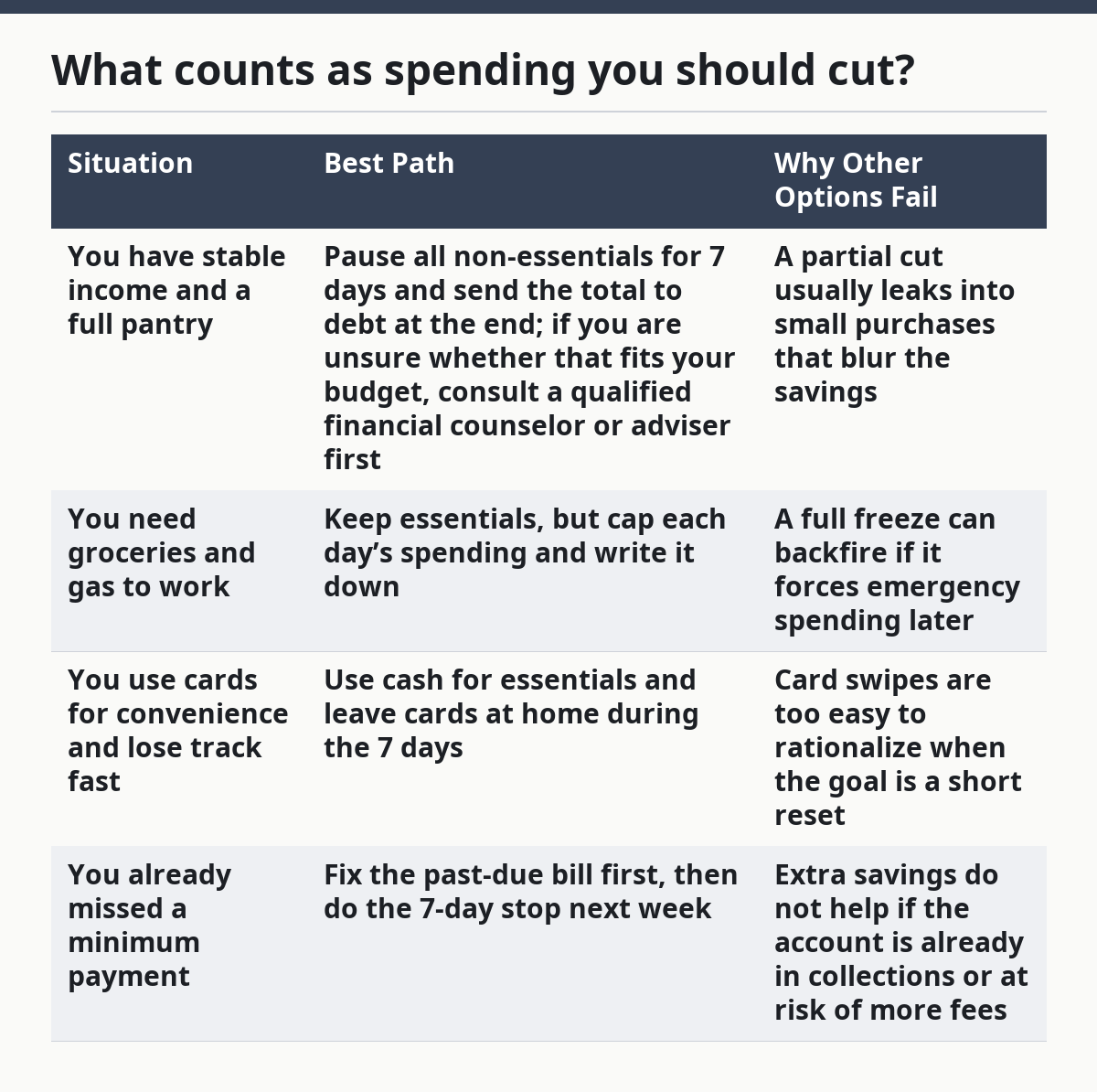
The standard advice gets this wrong when it treats every dollar the same. A coffee is not the same as insulin, rent, or a bus pass. The right question is not “Can I stop spending entirely?” It is “What can I stop without creating a bigger bill later?” Quick check: If a purchase prevents a fee, keep it in the essential bucket and cut something else, and if you are unsure, ask a qualified financial counselor or adviser.
How do you put the savings toward debt?
You put the savings toward debt by sending the money to one target as soon as the 7 days end, while keeping every minimum payment current. In debt snowball, the extra payment goes to the smallest balance first after essentials and minimums are covered.
- Pick the debt that gets the extra money. In a debt snowball, that is the smallest balance, not the highest interest rate.
- Confirm every minimum payment is already covered. If a minimum is missing, the extra money usually needs to fix that first.
- Move the saved amount out of checking the same day you count it. If your bank allows scheduled transfers, set one for the first available date after day 7.
- Label the transfer with the debt name or account number so the money has one job. That helps prevent accidental reuse.
- Make the extra payment and verify it posts. When it works, the debt balance drops by the saved amount, minus any interest or posted fees that apply under that account’s terms.
Do not split the saved amount across several debts unless your plan is built that way on purpose. A split weakens the snowball effect because it slows the first payoff and gives you less visible progress. The whole point of a snowball is momentum. If the balance does not feel smaller after the payment posts, the plan becomes harder to repeat.
Quick check: If the saved money sits in checking for “later,” it is not yet part of your debt plan.
When is a 7-day spending stop the wrong move?
A 7-day spending stop is the wrong move when it would put essentials at risk, trigger fees, or ignore a bigger cash-flow problem. If one of those is true, the better move is a narrower plan, not a harsher one.
You should rethink the 7-day stop if any of these apply:
- Your rent, utilities, or transportation bill is due inside the 7 days and the money is not already set aside.
- You are behind on a minimum payment and need to stop the bleeding before you add extra.
- Your income changes during the week, such as tips, variable shifts, or freelance payments.
- Someone else in the household shares the card or account and is not on board with the freeze.
- Your budget is already so tight that cutting all discretionary spending would leave you with nothing for groceries by day 4.
If that is your situation, use a lighter version: a 48-hour pause, a cash-only rule for extras, or a “no new non-essential subscriptions” rule. Those options still create savings without turning the week into a crisis. A debt plan should remove pressure, not create a one.
Quick check: If the 7-day stop makes you anxious about food, gas, or fees, scale it down before you begin.
What changes the answer the most?
The answer changes most when your budget problem is either behavior or math. If the problem is habit, a 7-day stop can break the pattern. If the problem is that your bills are already larger than your income, the stop alone will not fix it.

Here is the cleanest way to sort that out:
- If you spend in small bursts that you barely notice, then the 7-day stop is a strong fit.
- If one oversized bill is the real issue, then the week should focus on that bill, not random cutbacks.
- If you have irregular income, then base the plan on the lowest reliable cash you expect in the week.
- If your debt payments are already late, then the first job is to stabilize the account, not to chase extra savings.
- If you know exactly where money leaks out, then a named rule works better than a vague promise.
That is why generic “just spend less” advice fails. It ignores the reason money disappears. A person with a delivery habit needs a different fix than a person who cannot cover gas on payday. One plan can look the same on paper and still be wrong in practice. Quick check: If you can point to the exact habit or bill that keeps breaking your budget, you are ready for a targeted plan.
What should you do on day 8?
On day 8, you should turn the saved amount into one scheduled debt payment and then restart normal spending only with a tighter rule. The savings are not a prize to absorb into routine spending; they are the first payment in the next snowball round.

A simple day 8 reset looks like this:
- Review the 7-day total you saved.
- Confirm the debt target and the next minimum due date.
- Move the saved money to the debt account or scheduled payment.
- Check whether any essential spending got missed during the week.
- Decide one rule for the next 7 days, such as no delivery, no impulse buys, or cash only for extras.
If the week worked, repeat it later. If it failed because you ran out of groceries or missed a bill, change the guardrails before trying again. The goal is not punishment. The goal is a repeatable pattern that keeps debt payments moving.
Quick check: If you end day 7 with cash still sitting in checking and no debt payment scheduled, the week is not finished.
FAQ
Can I still buy groceries during a 7-day spending stop?
Yes. Groceries are usually an essential, not a luxury, so they stay in the plan. The key is to buy only what you need for the week and keep the receipt or note so you know what remained available for debt.
Should I use cash or a debit card for the 7 days?
Cash is often easier if card swipes are your weak spot. A debit card can work if you track every purchase immediately, but it is easier to blur the line between essentials and extras.
What if I save only a small amount?
That still counts if it becomes a real debt payment. A small extra payment is better than no extra payment, especially if it helps you build the habit of sending saved money to one debt instead of drifting back into spending.
Does the 7-day stop replace a budget?
No. It is a short reset, not a full budget system. A budget tells you what each dollar should do over time; the 7-day stop simply creates extra room so you can attack debt faster.
What if I have more than one debt?
Then the debt snowball still points you to one target at a time after minimums are covered. Splitting extra money between several balances usually slows the visible progress that keeps the plan going.
Drafted with AI; not yet reviewed by a person.