Last updated: November 28, 2026
Quick answer: use one written payoff order, one shared minimum-payment rule, and one extra-payment target. In a debt snowball with a partner, the goal is to agree on one payoff order before the next due date, then follow it in the joint budget. That is the point of a debt snowball with a partner: how to agree on one payoff order.
Key takeaways
- Pick one list of debts, not two separate systems.
- Decide the order before extra money hits the account.
- Keep every minimum payment current so the plan stays on track.
- Put the rules in writing in the joint budget, even if the list is short.
- If the same debt keeps causing fights, the problem is usually the rule, not the math.
Who this is for
This guide is for two people sharing money decisions who want to use the debt snowball method without repeating the same argument every month. It assumes you already know the basics: smallest balance first, then roll that payment into the next debt after a balance is paid off. If you need the plain definition, the debt snowball method is the payoff system where you attack debts from smallest balance to largest balance while paying minimums on everything else.
This is information, not financial advice. Money rules vary by country, and a qualified adviser should be consulted for your own situation if your debts are tied to taxes, business income, a legal separation, or a loan structure you do not fully understand. The method also needs extra care if one partner controls the accounts, one income is unstable, or either person is already missing minimum payments.
This page applies best when both partners can see the full list of debts, including credit cards, personal loans, and a car loan. It does not solve who is legally responsible for each debt. It only helps two people agree on a single payoff order and stick to it without hidden side rules.
How do you pick one debt order together?
You pick one debt order together by agreeing on the same ranking rule, then checking each debt against the real-life budget before you lock it in. For a classic debt snowball, the ranking rule is simple: smallest balance first. The hard part is not the math; it is making sure both people can live with the order for 3 months, 6 months, or longer without changing it midstream.

Start with every debt on one page: creditor name, balance, minimum payment, and due date. Add credit cards, personal loans, and a car loan even if one partner cares more about one account than another. Then sort by balance from smallest to largest, because the snowball method depends on a fixed order rather than a moving target.
If two debts are close in size, do not keep re-sorting them every week. Pick one tiebreaker and write it down, such as “lowest balance wins” or “earliest due date wins.” A tie that changes every month turns the plan into an argument instead of a system.
How do you build the list without arguing?
You build the list by putting both partners’ debts on the same sheet, then using one shared rule for the order and one shared rule for the extra payment. The shared sheet matters because hidden debts or half-finished lists are where snowball plans usually break.
Use this sequence:
-
List every debt with a balance and minimum payment. Write the exact creditor, the current balance, and the monthly minimum for each credit card, personal loan, and car loan. Verify that no account is missing and that both partners can see the same list. A missing account can make the “smallest” debt look smaller than it is.
-
Choose one ranking rule and stick to it. For the debt snowball method, sort by smallest balance first. Verify that both people say the same rule out loud. If one person keeps changing the rule to match a favorite account, the plan has already started to drift.
-
Decide whether the snowball uses one income stream or both. Put the agreed amount into the joint budget before any extra payment is assigned. Verify that the number still leaves room for minimum payments, groceries, housing, and transport. If the plan depends on money that is not stable, the order may be fine but the payment plan is not.
-
Assign minimum payments to every debt. Every debt gets its required minimum payment on time, every month, before extra money goes to the target debt. Verify each due date and autopay setting. If a minimum payment is skipped, the plan may stall, fees may add up, and the smallest debt may stop being the best first target.
-
Put all extra money on the first debt only. The extra payment goes to one account, not two, until that debt is gone. Verify that the extra amount is not quietly being split for “balance.” If the extra payment is spread across debts, the snowball loses its momentum.
-
Write the next debt in advance. Before the first debt is finished, name the second debt in the joint budget. Verify that both partners know where the freed-up payment will go next. If you wait until payoff day to decide, you are likely to revisit the argument.
-
Set a monthly check-in date. Once a month, review the balances, the due dates, and any new charges. Verify that the order still matches the written rule. If new spending keeps landing on the debt card, the problem is not the snowball order; it is the spending rule.
-
Keep one source of truth. Use one shared note, spreadsheet, or budget page so both people see the same list. Verify that the list updates after each payoff. If each partner keeps a separate version, one of you will be working from old numbers.
For a simple budget worksheet, keep the list visible and dated.
What should go in the joint budget?
The joint budget should show the same debt order, the same minimum payments, and the same extra amount in one place. That keeps the payoff plan from turning into a private project. A budget without the debt list is just a spending sheet; it does not settle the argument about where the next dollar goes.

The budget needs three parts: fixed bills, minimum debt payments, and the snowball payment. Put the minimum payments in the month they are due, not just in a generic “debt” line. Then label the target debt by name so the payment has an address, not just a category.
A useful rule is to keep the budget boring. The more special cases it contains, the easier it is for one partner to say, “Just this once.” If a one-time exception lasts for several months, it is no longer an exception; it is a second payoff system.
For a practical reference on budgeting and debt tracking, the Consumer Financial Protection Bureau has budgeting tools at https://www.consumerfinance.gov/consumer-tools/budgeting/ and the FTC’s debt guidance at https://consumer.ftc.gov/articles/dealing-debt. The CFPB also explains budgeting basics at https://www.consumerfinance.gov/consumer-tools/budgeting/ and the FTC explains debt repayment options at https://consumer.ftc.gov/articles/dealing-debt.
What if one partner wants avalanche and the other wants snowball?
If one partner wants avalanche and the other wants snowball, the first step is to agree on one method for a fixed period and stop switching between them. Avalanche means highest interest rate first; snowball means smallest balance first. The methods can lead to different orders, so mixing them in the same month creates confusion.
| Method | What decides the order | Main advantage | Main drawback |
|---|---|---|---|
| Debt snowball | Smallest balance first | Faster visible wins for many couples | May leave a higher-rate debt waiting longer |
| Avalanche | Highest interest rate first | Can reduce interest cost over time | Slower emotional payoff on small balances |
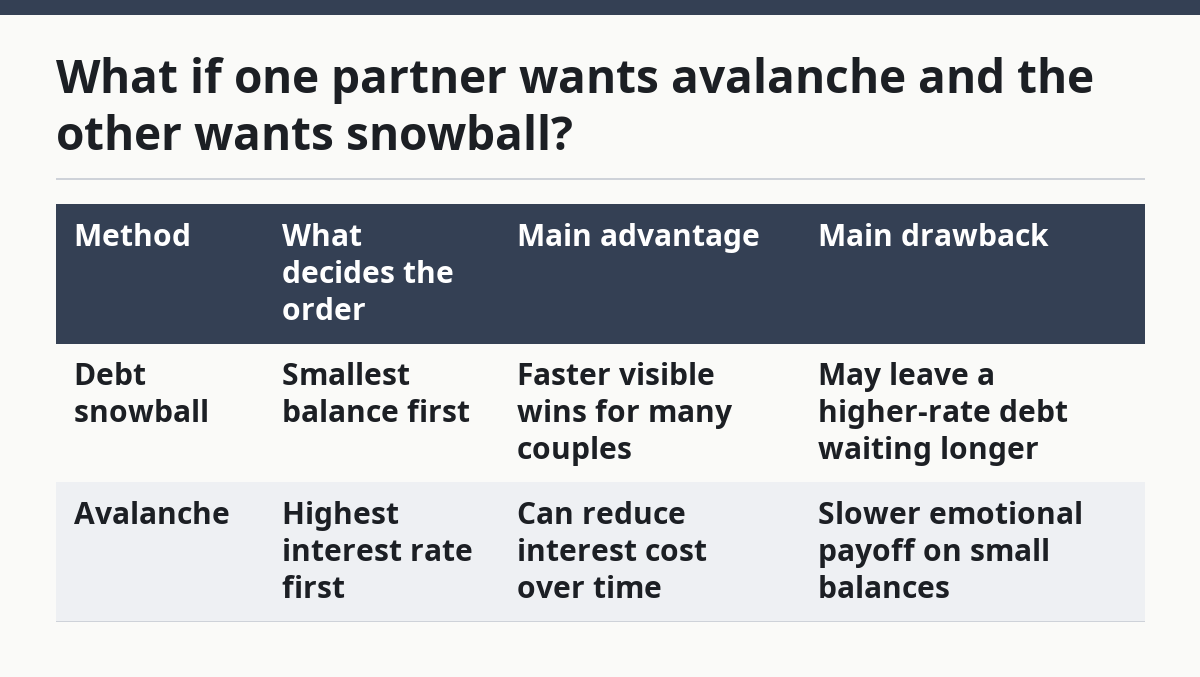
If the disagreement is really about motivation, the snowball is often easier for a couple to maintain because the first payoff arrives sooner. If the disagreement is really about cost, avalanche may feel more logical. The important part is not proving one partner wrong; it is choosing one rule you can both follow for the next 12 months, not just the next paycheck.
A compromise that works in some households is to keep the debt snowball order but add a monthly review date. That gives the more numbers-focused partner a chance to check the plan without changing it every week. What does not work well is hybrid math: snowball for one debt, avalanche for another, and “gut feel” for the third.
What mistakes actually cause fights?
The biggest mistakes are usually small rule changes that look harmless but break the plan. The debt snowball depends on consistency, so even a few exceptions can drag out the payoff timeline and turn every payment into a debate.
-
Changing the payoff order after every new bill. This makes the plan feel unstable and erodes trust. The better alternative is to set the order once and revisit it only at the monthly check-in.
-
Forgetting minimum payments on the non-target debts. This can trigger late fees or damage the plan’s structure. The better alternative is to automate minimums first, then send all extra money to the target debt.
-
Calling a shared debt “my debt” or “your debt.” That language turns a joint budget into a scorekeeping exercise. The better alternative is to label debts by account and agree on the shared order, even if one person feels more attached to a certain bill.
-
Using the snowball for a debt that keeps getting recharged. If the credit card is still being used, the balance may not fall the way the plan expects. The better alternative is to change the spending rule for that card before relying on the payoff order.
-
Skipping the written rule because the plan seems obvious. A plan that feels obvious in January may be easy to forget in April. The better alternative is a short written list with the payoff order, minimum payments, and next debt.
When should you stop and change the plan?
You should stop and change the plan when the debt snowball is no longer matching the household reality. That does not mean the method failed; it means the setup needs repair.
A minimum payment is already late: the plan is under strain, and the smallest-balance-first order is not the main issue — pause the extra-payment strategy and cover the delinquency first.
One partner does not have access to the list or the accounts: the budget is not truly joint — fix visibility before deciding the next payoff, because hidden balances create repeat conflict.
The target card keeps getting used: the snowball is fighting new debt as fast as it pays old debt — close or block the spending path, or the balance will keep refilling.
The couple cannot agree on a single rule after one full budget meeting: the order is becoming a relationship problem, not a math problem — bring in a qualified adviser or counselor who can help structure the discussion.
The debts include legal, business, or tax complications: the standard consumer payoff order may not fit — get qualified advice before changing payment priorities.
One partner’s income changes month to month: a fixed extra-payment number may be too rigid — switch to a variable snowball amount that only uses confirmed cash after minimums are covered.
How do you keep both partners aligned?
You keep both partners aligned by making the plan visible, repeatable, and hard to reinterpret. A shared debt snowball works best when both people know the next debt, the next due date, and the exact rule for extra money before the month begins.

Use a 15-minute monthly review. Check the current balance, confirm every minimum payment, and mark whether the extra payment is still going to the same debt. If the review keeps running long, the issue is usually too many exceptions or an unclear budget line.
Because the plan is written, the best sign of alignment is steady consistency. Nobody has to ask, “Are we still doing the same thing?” because the answer is already in the budget. That is what keeps the plan from becoming a monthly negotiation.
FAQ
How do we decide which debt comes first if we disagree?
Use one written rule and make the order before the next payment date. If you are using the debt snowball method, that rule is usually the smallest balance first, with minimum payments on everything else. If you still disagree after one budget meeting, the problem is not the order alone; it is the lack of a shared system.
Should we combine both incomes into one snowball?
Combine both incomes only if both partners agree on the joint budget and can see how the money is used. The key question is not whether the income is in one account, but whether the debt order, minimum payments, and extra payment are shared. If that visibility is missing, a combined snowball can create more conflict than progress.
What if one partner wants avalanche and the other wants snowball?
Pick one method and use it consistently for a set period instead of switching back and forth. Snowball and avalanche rank debts differently, so a mixed approach often creates confusion and resentment. If the argument keeps returning, a qualified adviser can help sort the numbers and the decision-making process for your situation.
Drafted with AI; not yet reviewed by a person.